

Jan-Sep 2026 Global FCEV Sales at 7,591 Units… Down 19.4% YoY
- Hyundai Leads with 5,304 Units, 69.9% Share; Chinese CVs Down 50.4%
In Jan-Sep 2026, global sales of hydrogen fuel cell electric vehicles (FCEV) totaled 7,591 units, down 19.4% from 9,423 units in the same period last year. Sales grew in the first half on strong demand for the new NEXO, but Q3 sales fell 44.9% YoY to 2,925 units (from 5,313 units), turning cumulative results negative. The new-model effect in Korea and Chinese commercial vehicle deliveries, both concentrated in Q3 last year, created a high base.
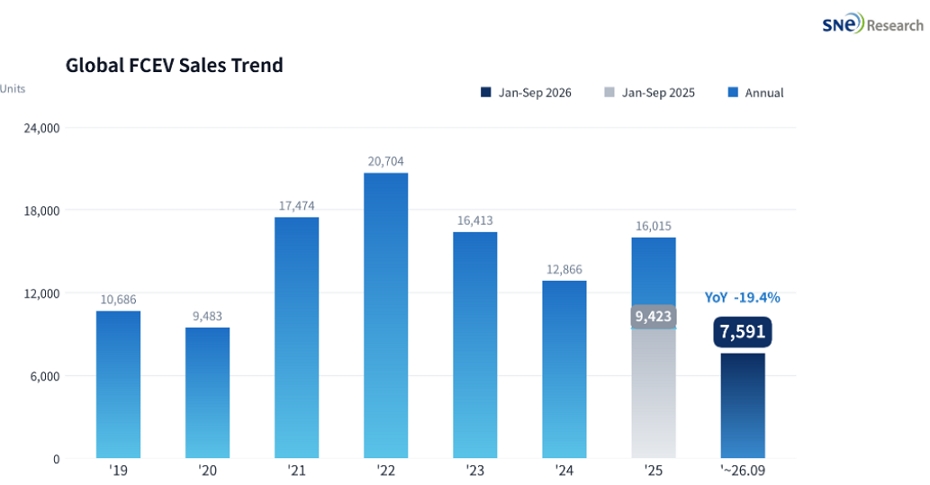
(Source: Global FCEV Monthly Tracker, October 2026, SNE Research)
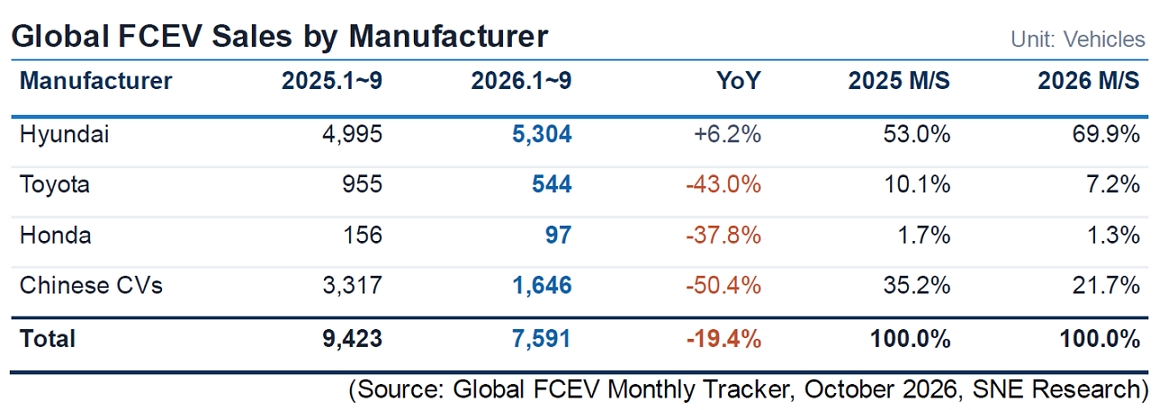
By company, Hyundai sold 5,304 units, led by the NEXO, up 6.2% YoY, and kept first place as its market share rose from 53.0% to 69.9%. Growth, which exceeded 160% in the first half, slowed sharply against a high base in the second half of last year, right after the launch of the second-generation NEXO. Hyundai's cumulative domestic FCEV sales passed 50,000 units in September, and the company is expanding its lineup beyond passenger cars to hydrogen buses and XCIENT fuel cell trucks.
Toyota sold 544 units, mainly the Crown and Mirai, down 43.0%, and its market share fell from 10.1% to 7.2%. With shrinking refueling infrastructure and limited sales regions constraining demand for hydrogen passenger cars, Toyota is shifting its focus to commercial vehicles, developing a light-duty truck with Isuzu that uses its third-generation fuel cell system and taking an equal stake in cellcentric, a European commercial vehicle fuel cell joint venture. Honda's CR-V e:FCEV sales were also limited to 97 units (-37.8%), and the company has scaled back the initial size of its next-generation fuel cell module production plan and pushed back the start of full-scale mass production. Chinese commercial vehicle makers sold 1,646 units, down 50.4%, as delays in follow-up policy implementation after the end of the first phase of the demonstration city program held back a sales recovery.
By country, Korea ranked first with 5,266 units, up 6.6%, for a 69.4% market share. China fell 50.5% to 1,642 units, with its share shrinking from 35.2% to 21.6%. In October, the Chinese government officially launched a hydrogen comprehensive application demonstration program for five city clusters, including Beijing-Tianjin-Hebei and the Guangdong-Hong Kong-Macao Greater Bay Area, providing up to CNY 1.6 billion per cluster over four years. Japan rose to 360 units (+19.6%), the US fell to 257 units (-9.2%), and Europe continued the steepest decline at 65 units (-88.4%). The EU AFIR requires hydrogen refueling stations every 200km along the TEN-T core network by 2030, but low vehicle adoption and high operating costs are holding back market growth.
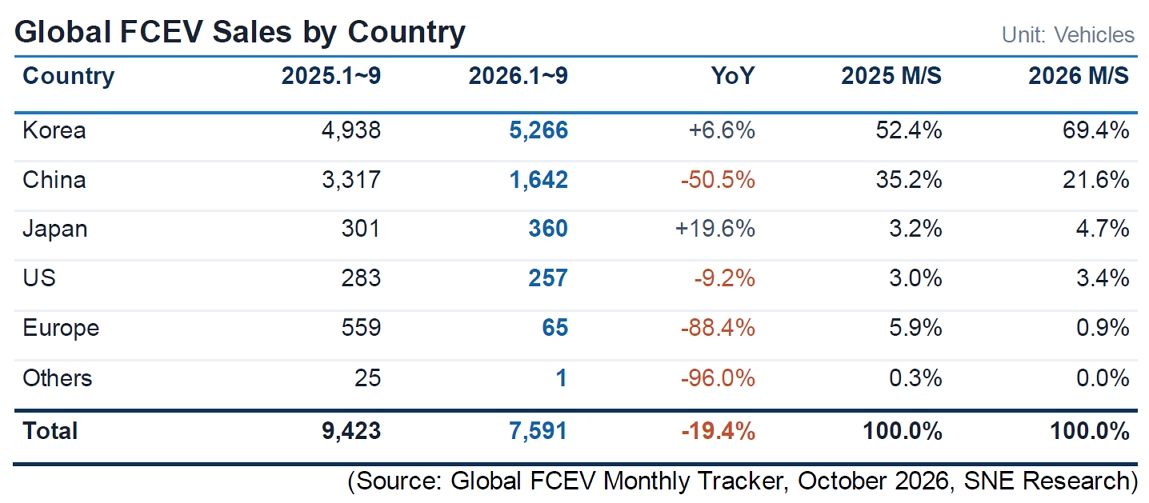
In Jan-Sep 2026, the global FCEV market contracted 19.4%, as a sharp drop in Q3 outweighed the first-half rebound. All major regions except Korea and Japan declined, and concentration deepened, with Korea alone accounting for nearly 70% of the market. Korea has passed 50,000 cumulative units, but the government's proposed 2027 FCEV subsidy budget was set at KRW 445.7 billion, 23% lower than this year, and refueling station expansion has fallen short of targets, making it a challenge to sustain growth momentum. China, by contrast, is targeting 100,000 fuel cell vehicles by 2030 through its new demonstration program, and in Europe mid- to long-term investment continues, including the rollout of hydrogen commercial trucks and BMW's plan to mass-produce the iX5 Hydrogen in 2028. The market's direction will therefore depend on Korea's subsidy execution and refueling infrastructure expansion, the actual pace of China's demonstration program, and whether hydrogen prices fall. FCEVs are more likely to grow as a complement to battery EVs in long-haul, heavy-duty, and high-utilization transport than through mass adoption in passenger cars.