

Global EV Battery Cathode Material Consumption Reaches 2,261K tons in Jan-Sep 2026, Up 21.9% Year-on-Year
- LFP share rises 4.7 percentage points to 65.5%, and ex-China consumption grows 31.2%
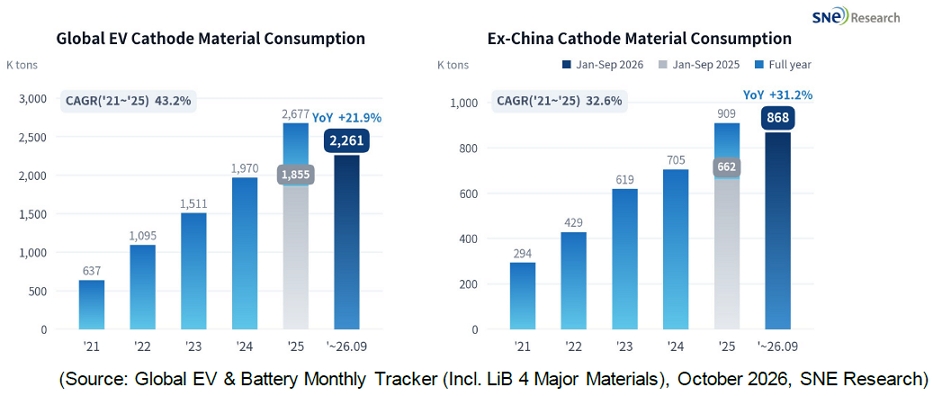
Global cathode material consumption for electric vehicles reached 2,261K tons in January-September 2026, up 21.9% from 1,855K tons a year earlier. Cathode consumption in the ex-China market rose 31.2% from 662K tons to 868K tons, above the global growth rate (21.9%), and its share of total consumption rose 2.7 percentage points from 35.7% to 38.4%.
By material, LFP grew 31.3% to 1,482K tons, and NCx rose 7.2% to 779K tons. LFP's share of total cathode material rose 4.7 percentage points from 60.8% to 65.5%. In the ex-China market, the LFP share rose 14.1 percentage points from 21.1% to 35.2%.
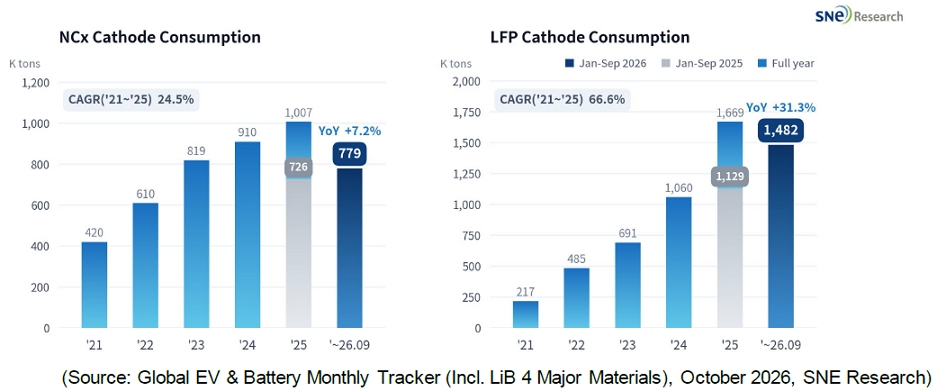
NCx (ternary) cathode material consumption reached 779K tons in January-September 2026, up 7.2% from 726K tons a year earlier. The difference in growth from LFP was 24.1 percentage points. Ternary cathode material is used mainly in models that require high energy density, and some Korean companies are expanding their LFP cathode businesses.
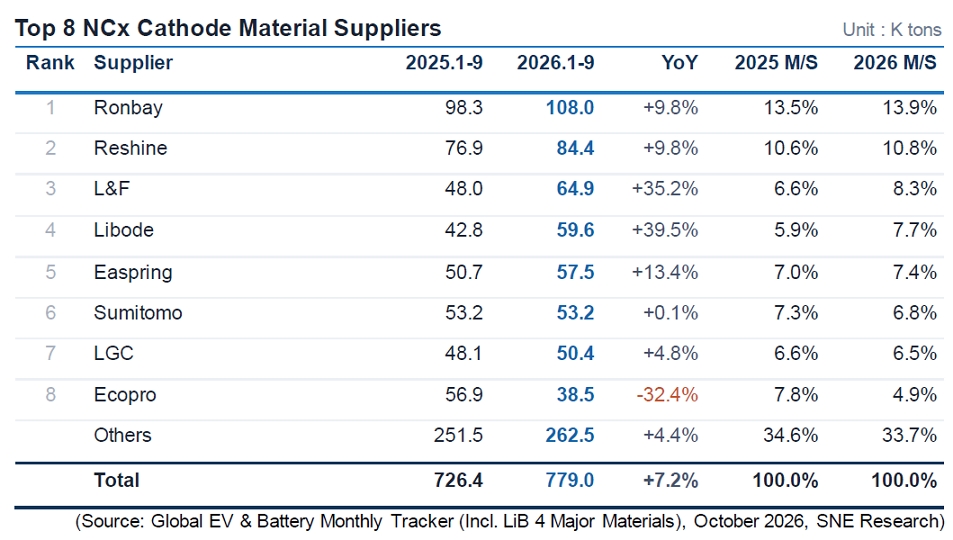
By supplier, Ronbay ranked first with 108.0K tons, up 9.8% year-on-year, and Reshine second with 84.4K tons, also up 9.8%. L&F rose 35.2% from 48.0K tons to 64.9K tons and ranked third, and Libode grew 39.5% to 59.6K tons, the highest growth rate among the top eight. Easpring's growth of 13.4% exceeded the growth of ternary cathode consumption (7.2%), while Sumitomo (53.2K tons) rose 0.1% and LGC (50.4K tons) 4.8%. Ecopro recorded 38.5K tons, down 32.4% year-on-year, and POSCO 34.8K tons, down 35.6%.
Korean companies are broadening their production bases and product lines. L&F made its first shipment of trial products in August from its dedicated LFP cathode plant in Dalseong, Daegu, and Ecopro began shipping mass-produced high-nickel cathode material from its Debrecen plant in Hungary in June. Meanwhile, lithium carbonate prices have fallen sharply since September, which is likely to affect cathode selling prices linked to raw material costs.
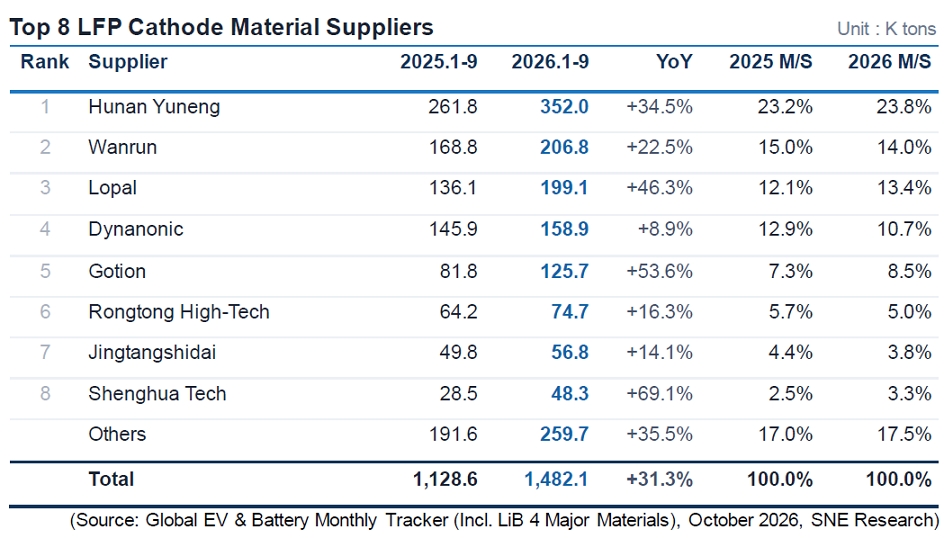
LFP cathode material consumption rose 31.3% to 1,482K tons from 1,129K tons a year earlier. Most of the increase in cathode consumption in January-September came from LFP.
Among LFP suppliers, Hunan Yuneng ranked first with 352.0K tons, up 34.5% year-on-year. The gap between second-placed Wanrun (206.8K tons, 22.5%) and third-placed Lopal (199.1K tons, 46.3%) was 7.7K tons, and Dynanonic ranked fourth with 158.9K tons, up 8.9%. Gotion and Shenghua Tech grew 53.6% and 69.1% respectively, above the overall growth of LFP cathode material (31.3%), while Rongtong High-Tech (16.3%) and Jingtangshidai (14.1%) grew below it.
In the LFP cathode market, Chinese suppliers vertically integrated from raw materials to finished material hold a large share. With lithium carbonate prices falling since September, some suppliers recorded losses on transactions intended to reduce price risk. The Chinese government is maintaining its stance against excessive competition in the industry, and a consumption tax has been levied on lithium-ion batteries sold domestically since September.
By corporate nationality, shares were 87.2% for Chinese suppliers, 9.1% for Korean suppliers and 3.7% for Japanese suppliers, compared with 83.8%, 12.1% and 4.1% respectively a year earlier. LFP supply agreements between Korean material and cell makers are also continuing. In October, POSCO Future M signed a long-term LFP cathode supply agreement of about KRW 6 trillion with Samsung SDI, covering supply from 2027 to 2032.
Going forward, local production and product lines that meet regional supply-chain rules are expected to be key competitive factors. In Europe, the proposed Industrial Accelerator Act (IAA), which would phase in requirements to source key components such as cells and cathode materials within the EU, is under legislative negotiation, and the battery passport under the EU Battery Regulation takes effect in February 2027. China's export controls on lithium batteries, cathode materials, synthetic graphite anode materials and related technology, announced in October last year, remain suspended until November 10 this year.