

Global EV Sales Excluding China Reach 7.33 Million Units in January-September 2026, Up 30.0% Year-on-Year
- Asia (ex-China) up 74.7% and Europe up 32.2%, while North America falls 25.2%
(Source: Global EV and Battery Monthly Tracker, October 2026, SNE Research)
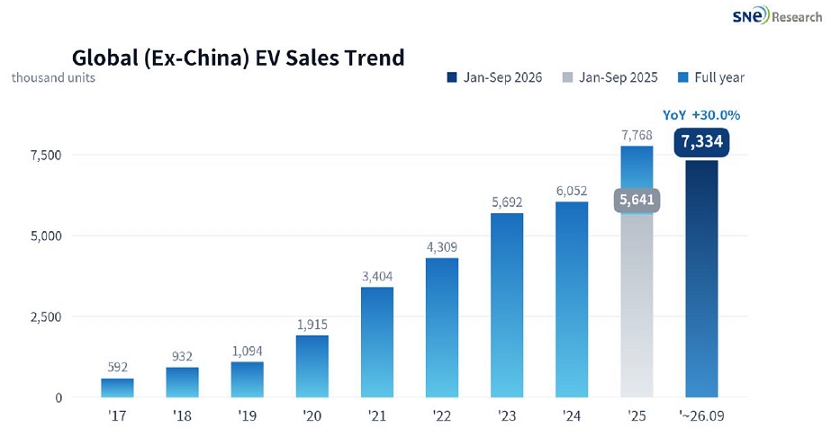
Global EV (BEV+PHEV) sales excluding China reached 7.33 million units in January-September 2026, up 30.0% from 5.64 million units a year earlier. Growth in the ex-China market exceeded global growth (5.8%). September sales rose 28.5% from a year earlier to 1.04 million units. By type, BEVs grew 33.4% to 5.49 million units and PHEVs 21.0% to 1.85 million units, and the BEV share rose from 72.9% to 74.8%.
(Source: Global EV and Battery Monthly Tracker, October 2026, SNE Research)
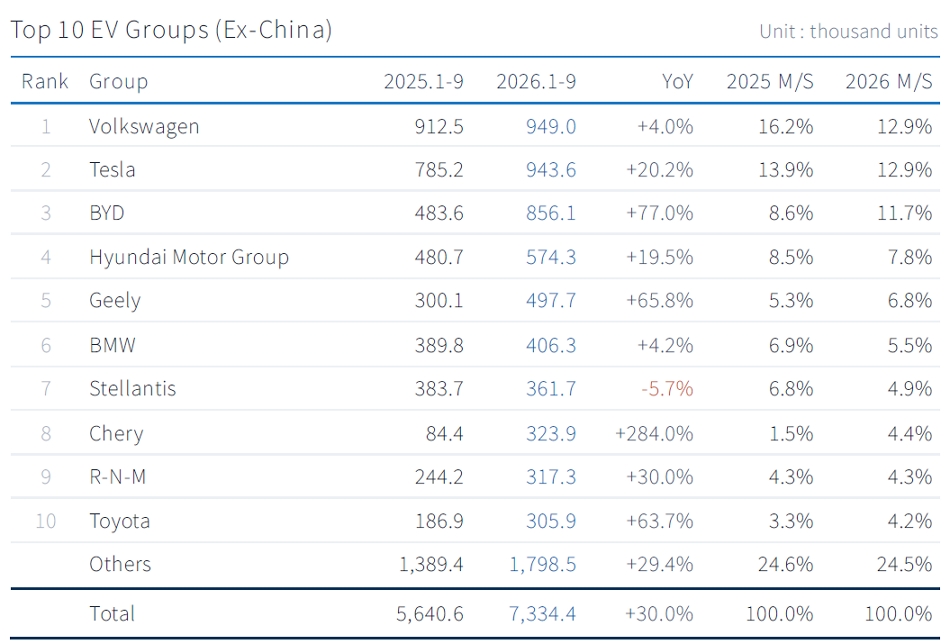
By company, Volkswagen ranked first with 949,000 units. It grew 4.0% year-on-year, and its share fell 3.3 percentage points from 16.2% to 12.9%. Its European deliveries rose 12.9%, while North America fell 74.3%. Its lead over second-placed Tesla is about 5,000 units, so the two groups' fourth-quarter results will be watched closely for the full-year ranking.
Tesla grew 20.2% to 944,000 units and ranked second. Its share fell 1.0 percentage point year-on-year to 12.9%, the same as Volkswagen when rounded to one decimal place. North American deliveries fell 2.3% to 457,000 units, while Europe and Asia (ex-China) rose 29.7% and 75.8% respectively.
BYD grew 77.0% to 856,000 units and ranked third, with its share up 3.1 percentage points from 8.6% to 11.7%. European deliveries rose 78.8% to 300,000 units, and Asia (ex-China) grew 55.9% to 194,000 units. Its gap with second-placed Tesla is about 88,000 units.
Hyundai Motor Group ranked fourth with 574,000 units, up 19.5% year-on-year. Its deliveries rose 23.4% in Europe and 64.3% in Asia (ex-China). Its gap with fifth-placed Geely is about 77,000 units.
Chinese groups posted high growth rates. Chery rose 284.0% to 324,000 units, the highest growth rate among the top 10 groups, and Geely grew 65.8% to 498,000 units. Geely's deliveries in Asia (ex-China) rose 221.9%. Toyota grew 63.7% to 306,000 units, R-N-M 30.0% to 317,000 units and BMW 4.2% to 406,000 units, while Stellantis fell 5.7% to 362,000 units.
Groups outside the top 10 grew 29.4% to 1.80 million units, and their share was 24.5%, similar to 24.6% a year earlier. Eleventh-placed Mercedes-Benz and 14th-placed Ford fell 1.7% and 10.5% respectively, while 12th-placed VinFast and 13th-placed SAIC grew 85.0% and 33.8% respectively.
(Source: Global EV and Battery Monthly Tracker, October 2026, SNE Research)
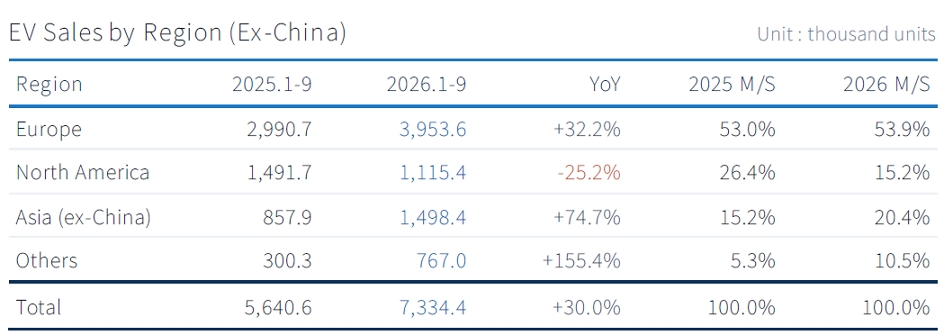
By region, Europe had the largest volume in the ex-China market with 3.95 million units, up 32.2% year-on-year, and its share rose from 53.0% to 53.9%. By country, Italy (73.5%), France (54.3%), Germany (42.1%), the UK (33.9%) and Spain (32.8%) increased.
North America fell 25.2% to 1.12 million units, and its share dropped 11.2 percentage points from 26.4% to 15.2%. U.S. deliveries fell 31.6%, while Canada (25.3%) and Mexico (18.4%) increased. U.S. deliveries in the third quarter were at a similar level to the second quarter, but the decline is large compared with the third quarter of last year, when purchases were concentrated ahead of the end of the tax credit. Other regions grew 155.4% to 767,000 units, and their share rose from 5.3% to 10.5%.
Deliveries in Asia (ex-China) rose 74.7% year-on-year to 1.50 million units, and its share increased 5.2 percentage points from 15.2% to 20.4%. Korea, the largest market in the region, grew 69.4%, and Indonesia (116.1%), Thailand (78.0%), Vietnam (75.9%), Japan (69.3%) and India (59.4%) also increased.
The ex-China EV market grew 30.0% in January-September 2026. By region, deliveries rose in Europe, Asia (ex-China) and other regions, while North America declined. Among the top 10 groups, the combined share of three Chinese groups, BYD, Geely and Chery, rose from 15.4% a year earlier to 22.9%. Through year-end, the extent of the U.S. recovery, whether European demand holds up, and automakers' expansion of local production amid discussions on EU local content rules are expected to affect company shares in the ex-China market.