

Global (Ex-China) EV Battery Usage[1] in January-August 2026[2] Reaches 360.5 GWh, Up 23.7% Year-on-Year
- CATL and BYD's combined
share rose 7.5 percentage points to 44.7%, extending Chinese suppliers' reach
outside China
Total battery usage in electric vehicles (EV, PHEV, HEV) sold in the global market excluding China came to approximately 360.5 GWh in January-August 2026, up 23.7% year-on-year. This was 4.0 percentage points above the global growth rate (19.7%), but growth in the single month of August slowed to 9.0%, making the effect of weak North American demand more visible in monthly results.
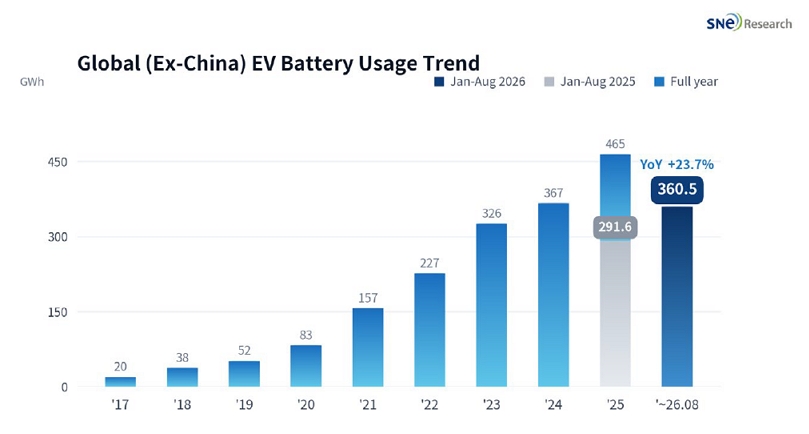
(Source: Global EV and Battery Monthly Tracker, September 2026, SNE Research)
In January-August 2026, the combined ex-China usage of the three Korean battery makers, LG Energy Solution, SK On and Samsung SDI, was 96.5 GWh, down 12.8% year-on-year. Their combined share fell 11.1 percentage points from 37.9% to 26.8%. The decline was concentrated in North America, where the three companies' usage dropped 46.5% from 47.4 GWh to 25.3 GWh, while Europe rose 5.2% from 49.9 GWh to 52.5 GWh and Asia rose 33.0% from 11.2 GWh to 14.8 GWh.
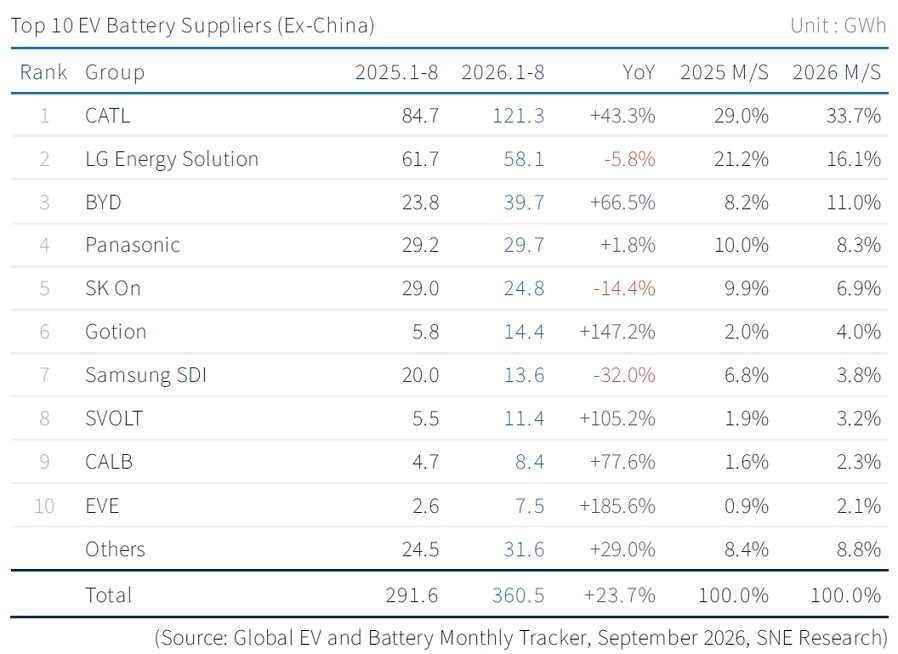
LG Energy Solution recorded 58.1 GWh, down 5.8% year-on-year, but held second place in the ex-China market. Usage in Europe rose 9.8% to 31.3 GWh and in Asia 44.4% to 9.2 GWh, but North America fell 42.3% from 25.2 GWh to 14.6 GWh, dragging down overall results. Its share declined 5.1 percentage points from 21.2% to 16.1%. Converting North American plants to ESS and broadening its European customer base are seen as the tasks for recovering share.
SK On's usage fell 14.4% to 24.8 GWh, and its share declined 3.0 percentage points from 9.9% to 6.9%. It supplies batteries to Hyundai Motor Group, Ford, Volkswagen and Mercedes-Benz, among others, but North American usage fell 41.8% and Europe also declined 1.5%. In September, SK On signed an LFP cathode purchase agreement worth about KRW 1.1 trillion with POSCO Future M and decided to grow its North American ESS business around its Georgia plant, diversifying its sources of demand.
Samsung SDI fell 32.0% to 13.6 GWh, the largest decline among the top 10 suppliers. Its share contracted 3.0 percentage points from 6.8% to 3.8%. European usage was flat at 8.3 GWh, but North America plunged 62.0% from 10.4 GWh to 3.9 GWh. As major customers such as BMW, Audi and Rivian continue to adjust the pace of electrification, the key to future results is how far expanded ESS cell supply in the United States can fill the gap left by EV demand.
Panasonic ranked fourth with 29.7 GWh, up 1.8%. Tesla volumes in North America supported its results, but with growth well below the ex-China market rate its share fell 1.7 percentage points from 10.0% to 8.3%. Given its Tesla-centered customer base, mass production of next-generation cylindrical cells and the expansion into non-EV applications remain variables for growth.
CATL recorded 121.3 GWh in the global (ex-China) market in January-August 2026, up 43.3% year-on-year. Its share rose 4.7 percentage points from 29.0% to 33.7%. European usage grew 30.4% from 61.8 GWh to 80.6 GWh, and usage in Asia more than doubled to 24.0 GWh. In September its plant in Debrecen, Hungary began trial cell production, which is expected to broaden its local supply base in Europe.
Later-entrant Chinese suppliers such as Gotion, SVOLT, CALB and EVE also grew steeply. Gotion rose 147.2% to 14.4 GWh, SVOLT 105.2% to 11.4 GWh and CALB 77.6% to 8.4 GWh. EVE grew 185.6% to 7.5 GWh, the highest growth rate among the top 10. The combined share of six Chinese suppliers including CATL and BYD rose 12.6 percentage points from 43.6% to 56.2%, exceeding half of the ex-China market.
BYD kept third place with 39.7 GWh, up 66.5%, and its share rose 2.8 percentage points from 8.2% to 11.0%. Growth was broad-based across Europe (14.5 GWh, up 65.6%), Asia (13.2 GWh, up 41.7%) and South America (6.2 GWh, up 138.5%). With overseas sales reaching a monthly record in August and exports and local production of its own EVs expanding rapidly, its usage growth in the ex-China market is likely to continue for the time being.
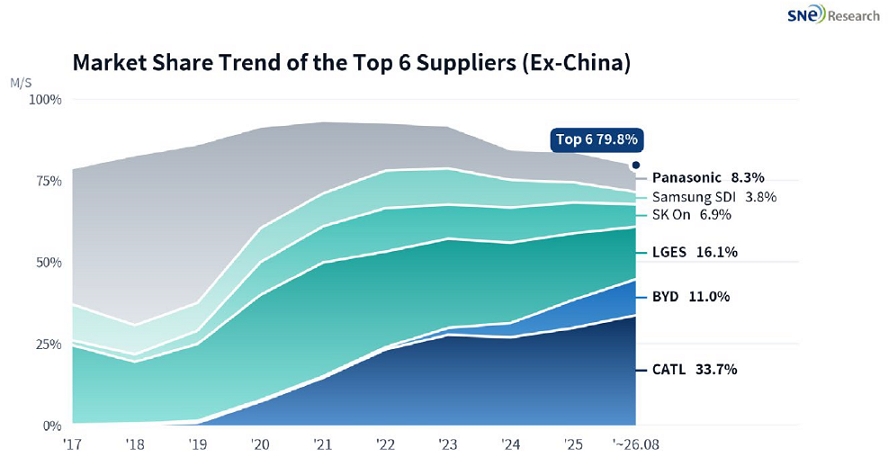
(Source: Global EV and Battery Monthly Tracker, September 2026, SNE Research)
The ex-China market grew 23.7% in January-August 2026, but supplier performance diverged sharply. The shares of the three Korean suppliers and Panasonic fell together, while Chinese suppliers rapidly increased volumes in Europe, Asia and South America. The 11.9 percentage point rise in the ex-China LFP share, from 15.6% to 27.5%, points in the same direction. In North America, Ford began producing LFP cells licensed from CATL technology, and in Europe LFP adoption is increasing in entry-level models, making price competitiveness a core criterion in supplier selection.
Going forward, regional policy and diversification of demand will determine supplier competitiveness. In North America, where EV demand has weakened since the tax credit ended, battery makers are focused on keeping plants running on ESS and data center demand. In Europe, discussions on stricter requirements for locally produced components continue while Chinese suppliers ramp up local plants, so local production capability, price competitiveness and supply-chain traceability ahead of the battery passport in February 2027 are expected to be the key variables determining market position.
[2] Based on batteries installed in EVs registered during the period.