

Global LFP Cathode Material Shipments Forecast to Surge 51% YoY to 5.24 Million Tons in 2026
- LFP cathode materials have become a mainstream choice, driven by the shift toward more affordable EVs and surging demand for ESS, including AI data center applications
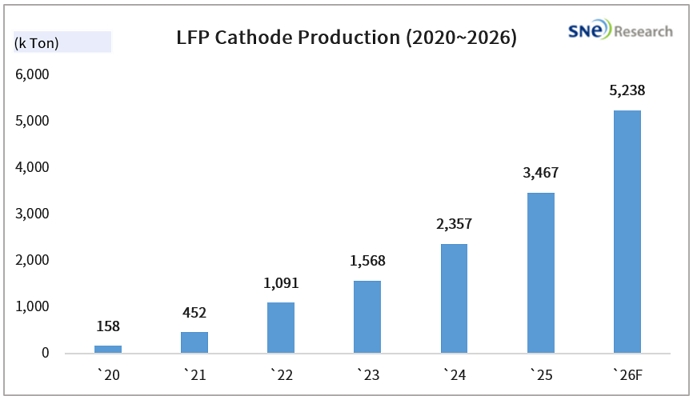
- LFP cathode material shipments are expected to reach 5.24 million tons in 2026, up 51% from 3.47 million tons in 2025, with their market share rising from 72% to 77%
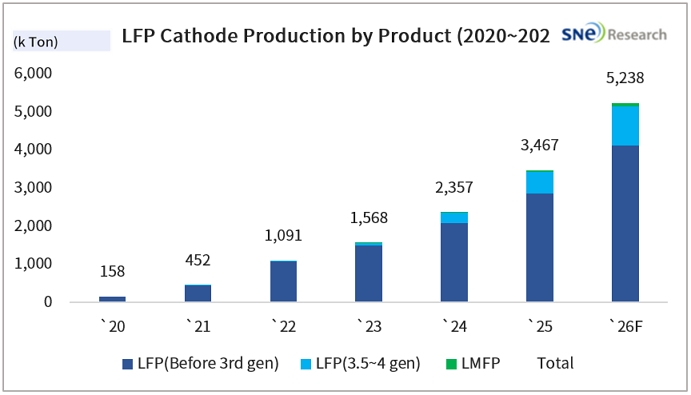
- While the market for third-generation and earlier LFP products remains oversupplied, major Chinese players are accelerating production of higher-density, 3.5th- to 4th-generation and more advanced LFP materials
(Source: <2026>LFP/LMFP Cathode Material Processing Technology: Latest Trends and Key Manufacturers, SNE Research)
According to SNE Research’s recently published report, “2026 LFP/LMFP Cathode Material Processing Technology: Latest Trends and Key Manufacturers,” LFP (lithium iron phosphate) cathode materials are expected to account for approximately 77% of total lithium-ion battery cathode material shipments this year. Global LFP cathode material shipments are projected to increase from 2.36 million tons in 2024 and 3.47 million tons in 2025 to approximately 5.24 million tons in 2026.
Of the 3.70 million tons of cathode materials shipped globally in 2024, LFP accounted for 2.36 million tons, or 64% of the total. In 2025, LFP shipments reached 3.47 million tons out of approximately 4.95 million tons in total global cathode material shipments, representing around 72%. The strong growth momentum continued into the first half of 2026, with LFP shipments increasing 73% year over year and their share of total cathode material shipments expanding to 76%.
In China, LFP production reached approximately 2.70 million tons in the first half of 2026, up 73% year over year. Production capacity continues to expand at an accelerating pace, supported by high utilization rates among major producers and ongoing capacity additions. Amid robust demand, the average utilization rate across China’s LFP industry is estimated to have exceeded 80%, with some leading producers operating at or near full capacity.
At the same time, the Chinese government’s efforts to curb oversupply, coupled with growing supply constraints for raw materials and iron phosphate, have added pressure to the market. Against this backdrop, Hunan Yuneng, the world’s largest LFP cathode material producer, raised its LFP product prices by RMB 2,000 per ton starting in August. Supply has also begun to tighten for certain high-end, high-density premium LFP products.
LFP Cathode Material Market Poised for Continued Strong Growth in 2026 as ESS and AI Infrastructure Diversify Demand
The LFP market is expected to maintain strong growth momentum in 2026, supported by the simultaneous expansion of mass-market EVs and the global ESS market. At the same time, the demand base for LFP is rapidly diversifying into emerging applications, including AI data centers, battery recycling, and marine mobility.
In the first half of 2026, global ESS battery shipments reached 461.3 GWh, up 71% year over year. North America recorded shipments of 75.9 GWh, representing 83% year-over-year growth. Large-scale ESS projects outside China are also driving further growth in LFP demand. As a result, LFP applications are expanding beyond the traditional EV and ESS markets into AI data centers and industrial power infrastructure.
Cummins has secured a project to supply a 5 MWh liquid-cooled LFP battery energy storage system (BESS) designed to respond to rapid fluctuations in power loads at AI data centers. This development highlights the emergence of AI power infrastructure as a new source of demand for LFP batteries.
At the same time, the growing volume of end-of-life batteries and rising raw material prices are improving the economic viability of direct recycling and regeneration technologies for LFP batteries. As a result, the resource-circulation value of LFP is gaining greater attention even within the battery recycling industry, which has traditionally focused on NCM batteries.
(Source: <2026>LFP/LMFP Cathode Material Processing Technology: Latest Trends and Key Manufacturers, SNE Research)
2026 LFP Cathode Material Technology Trends — Competition Shifts Toward High Density, Ultra-Fast Charging, and LMFP
In 2026, competition in LFP technology is rapidly shifting away from the traditional focus on low cost and safety toward high density, ultra-fast charging, and improved low-temperature performance. To achieve higher density, manufacturers are making improvements across both material design and manufacturing processes, including particle size distribution and precursor design, optimization of calcination and milling conditions, and more uniform carbon coating and doping. In particular, achieving a compaction density of 2.6 g/cc or higher has emerged as a key development target for fourth-generation high-density LFP materials.
At the same time, LMFP is emerging as a next-generation phosphate-based cathode material, offering the potential for approximately 15–20% higher energy density than LFP and helping address LFP’s inherent energy-density limitations. While the incorporation of manganese (Mn) enables higher operating voltages, key development efforts are focused on carbon coating, doping, and particle and interface engineering to overcome the resulting challenges in electrical conductivity.
On the supplier side, Chinese manufacturers, led by Hunan Yuneng, Wanrun, Lopal, Dynanonic, and Gotion, continue to dominate the market. Competition is increasingly shifting toward higher-performance LFP products offering higher compaction density, higher energy density, and faster charging capabilities. Korean manufacturers, which entered the LFP market relatively later, are also accelerating pilot production and preparations for mass production, with L&F, POSCO Future M, and LG Chem stepping up efforts to address growing demand from the ESS market.
Looking ahead, the LFP/LMFP market is expected to maintain its growth trajectory, supported by expanding demand from ESS applications as well as mass-market and mid-range EVs. At the same time, amid potential oversupply and intensifying price competition resulting from large-scale capacity expansions, technological differentiation through high-density and high-performance products is expected to become increasingly important.