

Global EV Battery Electrolyte[1] Consumption Reaches 919K tons in Jan-Jul 2026,[2] Up 23.3% Year-on-Year
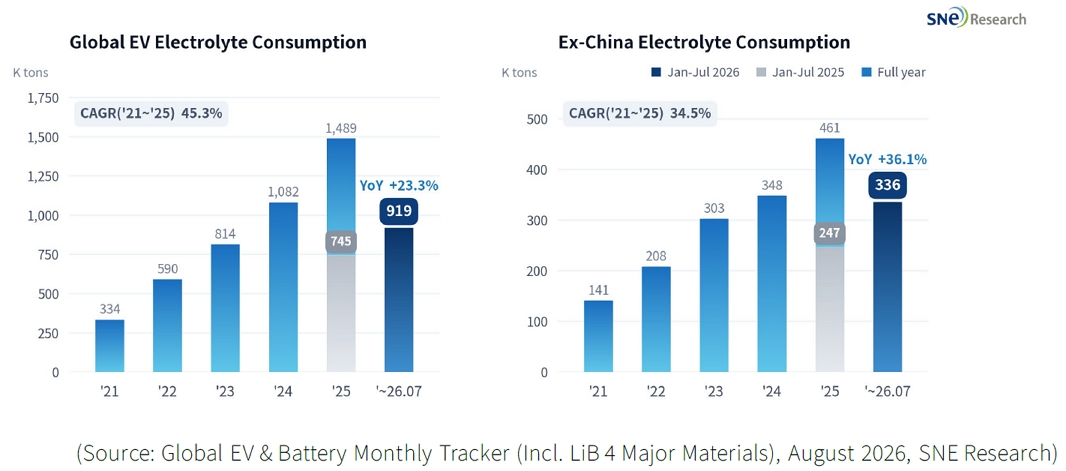
Total electrolyte consumption in electric vehicles (EV, PHEV, HEV) registered worldwide in January-July 2026 reached approximately 919K tons, a 23.3% increase from 745K tons a year earlier. Over the same period, the market excluding China recorded approximately 336K tons, growing 36.1% from a year earlier and posting a higher growth rate than the overall market. The ex-China share of total consumption also expanded 3.4 percentage points from 33.1% to 36.5%.
Electrolyte is a core material that helps lithium ions move smoothly between the cathode and the anode inside a lithium-ion battery. It directly affects a battery's charging performance and output, energy efficiency, cycle life and stability, and differences in battery performance arise depending on the combination of lithium salts, solvents and additives. As electric vehicle batteries move to higher voltages and fast charging and as demands for improved low-temperature performance and cycle life increase, competitiveness in electrolyte material design and additive technology is becoming even more important.
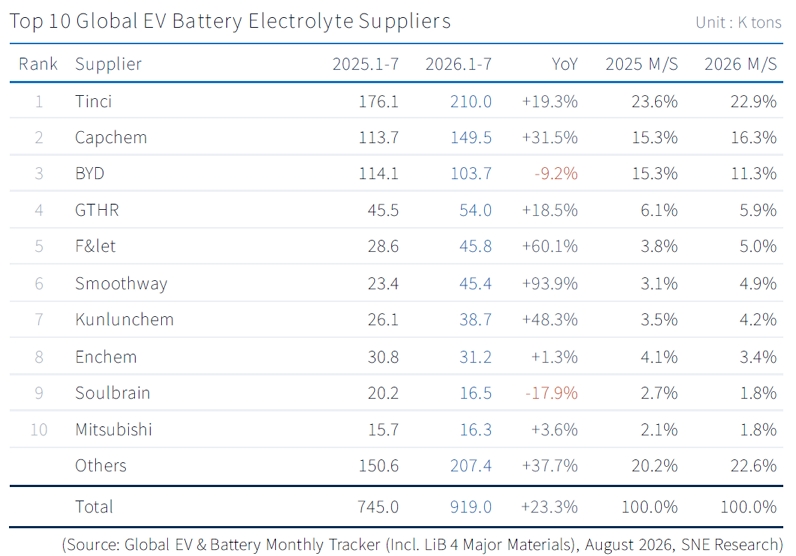
Growth diverged among major suppliers in the global electrolyte market in January-July 2026. Tinci recorded approximately 210K tons, a 19% increase from a year earlier, holding first place in the market, while Capchem consolidated second place with approximately 150K tons, up 32%. BYD, by contrast, fell 9% year-on-year to approximately 104K tons. Meanwhile, mid-tier Chinese suppliers including Smoothway (+94%), F&let (+60%), Kunlunchem (+48%) and GTHR (+19%) posted high growth rates and rapidly expanded their supply volumes. Among Korean suppliers, Enchem recorded approximately 31K tons, an increase of only 1%, while Soulbrain declined 18% to approximately 17K tons.
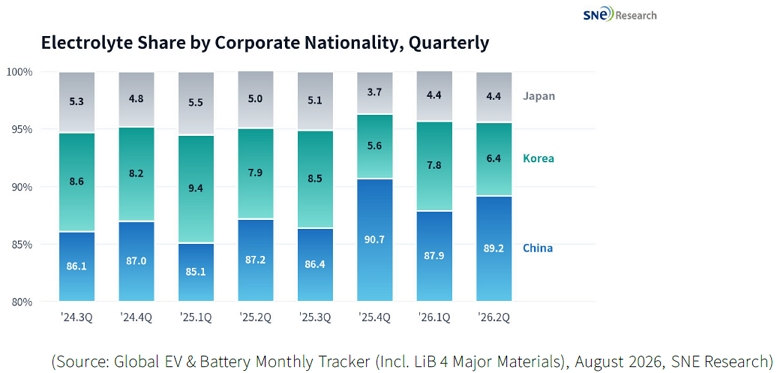
By corporate nationality, Chinese companies accounted for close to 90% of the market and maintained their leadership. In the second quarter of 2026, the Chinese share was 89.2%, up 2.0 percentage points from 87.2% a year earlier. Over the same period, Korean companies fell 1.5 percentage points from 7.9% to 6.4% and Japanese companies fell 0.6 percentage points from 5.0% to 4.4%. This shows that the supply advantage of Chinese suppliers in the electrolyte market is strengthening further, while the relative position of Korean and Japanese suppliers is narrowing.
The global electrolyte market continued solid growth in January-July 2026 on the back of increased battery installations in electric vehicles. In particular, the growth rate of the market excluding China exceeded that of the overall market by 12.8 percentage points, and expanding demand centered on North America, Europe and Asia (ex-China) is supporting market growth. However, even as demand in the ex-China market grows rapidly, supply has become more concentrated among Chinese suppliers, and the gap between demand regions and the nationality of supply has instead widened.
Recently, ESS as well as electric vehicle demand has emerged as a new axis of growth in the electrolyte market. With electrolyte supply for ESS using local production sites in North America and moves to expand supply for ESS in China and North America continuing, securing local production networks and utilization rates at existing facilities is emerging as an important factor in supplier competitiveness. At the same time, as the application of high-voltage and fast-charging batteries expands, the design of combinations of lithium salts such as LiPF6 and LiFSI with functional additives, and the ability to meet thermal stability, low-temperature performance and long cycle life requirements, are establishing themselves as the axes of technology competition. In addition, as the European Union specifies data requirements ahead of the battery passport mandate in February 2027, supply chain traceability capability is being added as a new variable.
[2] Based on battery installation for xEV registered during the relevant period.