

Global EV Battery Separator[1] Consumption Reaches 11,699 Mil m2 in Jan-Jul 2026,[2] Up 24.9% Year-on-Year
- Chinese separator suppliers held a 91.5% share in the second quarter of 2026, deepening the China-centered supply structure
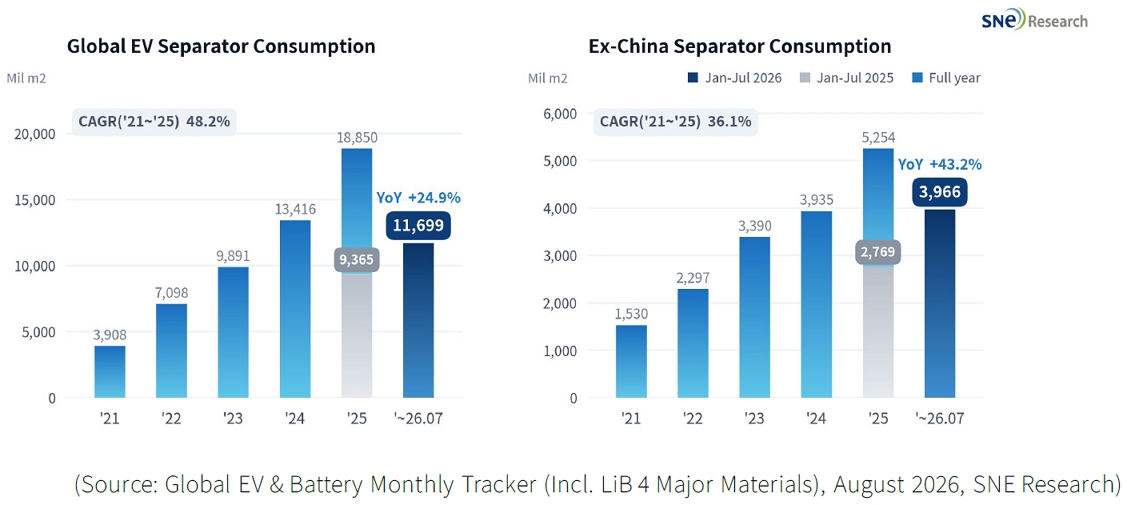
Separator consumption for batteries installed in electric vehicles (EV, PHEV, HEV) registered worldwide reached approximately 11,699 Mil m2 in January-July 2026, a 24.9% increase from 9,365 Mil m2 a year earlier. Over the same period, separator consumption in the global market excluding China reached approximately 3,966 Mil m2, growing 43.2% year-on-year and posting a rate of increase far above that of the overall market. Accordingly, the ex-China share of total consumption also rose from 29.6% to 33.9%, up 4.3 percentage points.
The separator is a core material that physically separates the cathode and the anode inside a lithium-ion battery to prevent short circuits, while providing a pathway for lithium-ion movement. It has a direct effect on battery safety, output performance and lifespan, and demand is rising steadily on the expansion of the electric vehicle market, the increase in battery capacity per vehicle, and the wider adoption of high-energy-density and fast-charging cells.
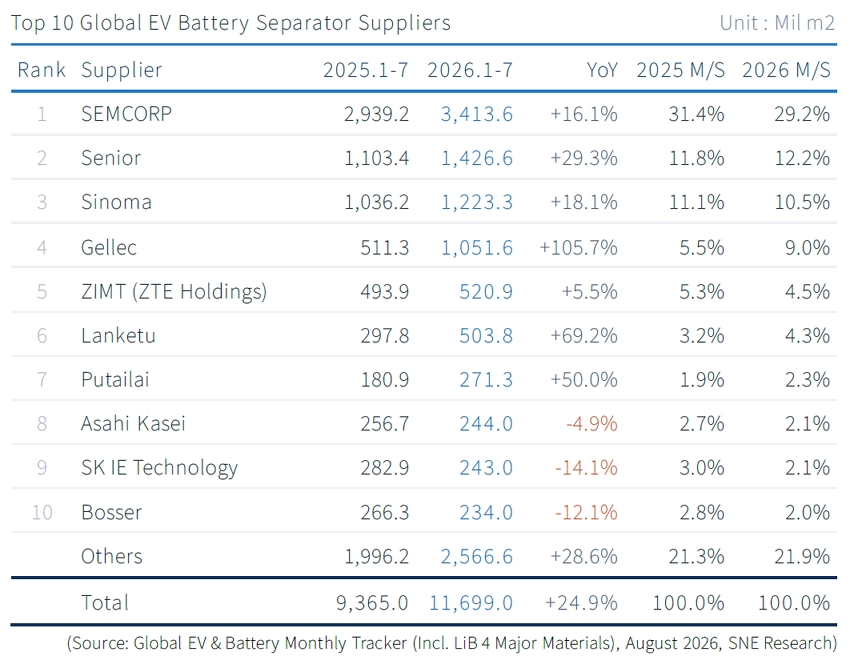
In the global separator market in January-July 2026, growth rates diverged markedly by major supplier. SEMCORP recorded approximately 3,414 Mil m2, growing 16% year-on-year and holding first place in the market, while Senior (+29%) and Sinoma (+18%) also maintained double-digit growth. Gellec in particular rose to fourth place with approximately 1,052 Mil m2 on 106% growth, and Lanketu (+69%) and Putailai (+50%) rapidly expanded their supply volumes. By contrast, ZIMT (ZTE Holdings) grew only 6%, while Asahi Kasei (-5%), SK IE Technology (-14%) and Bosser (-12%) saw their consumption decline.
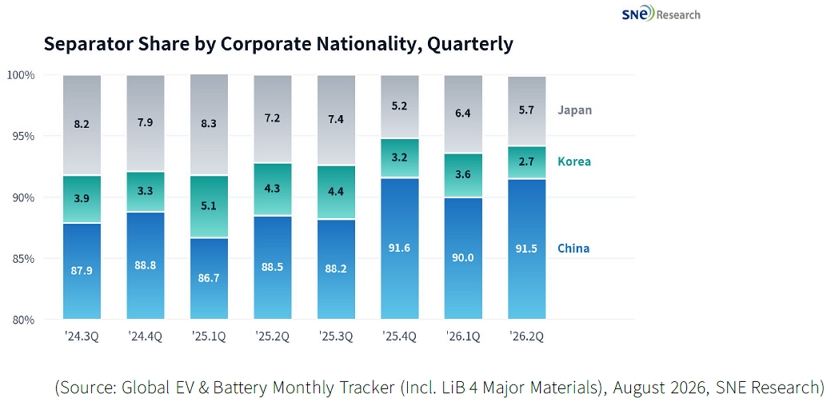
By corporate nationality, Chinese companies recorded a 91.5% share in the second quarter of 2026, accounting for most of the global separator market. Japanese companies were tallied at 5.7% and Korean companies at 2.7%. The share of Chinese companies rose 1.5 percentage points from 90.0% in the first quarter and 3.0 percentage points from 88.5% a year earlier, while year-on-year Japanese companies fell from 7.2% to 5.7% and Korean companies from 4.3% to 2.7%. As the scale and cost competitiveness of Chinese companies strengthen, Japanese and Korean companies appear to have no choice but to respond with a focus on high-value-added products.
The global separator market for electric vehicles continued a solid expansion in January-July 2026, supported by the increase in battery installations in electric vehicles and the rapid growth of the ex-China market. In China, expanded battery cell production and an LFP-centered product mix underpinned separator demand, while in the ex-China market, growing electric vehicle sales in Europe and Asia (ex-China), new model launches, and the increase in battery capacity per vehicle drove consumption growth. However, as Chinese companies absorbed a considerable portion of the demand increase, the structure in which the regional diversification of demand and the national concentration of supply move in opposite directions has become even more pronounced.
The separator market has recently seen continued price competition, with ample supply capacity for commodity products despite demand growth. As a result, yield and cost management and the ability to respond with high-value-added products such as ceramic coating, high heat-resistance and ultra-thin films are emerging as the key variables determining profitability, rather than a simple expansion of volume. At the same time, demand for batteries for ESS and data centers is expanding, and requirements for supply chain information management are becoming clearer, with the European Union releasing guidelines specifying data requirements by item ahead of the battery passport mandate taking effect in February 2027. Going forward, local production sites, customer diversification, high-value-added product portfolios and supply chain traceability capabilities are expected to be the factors that differentiate each company's market position.
[2] Based on battery installation for xEV registered during the relevant period.