

Global SMR Market Set to Shift from Early Commercialization to Full-Scale Growth, Reaching Up to 155 GWe Potential by 2050
- Initial growth driven by light-water designs and leading nuclear nations, followed by medium-to-long-term diversification in reactor types, regional expansion, and application spectrum
The global Small Modular
Reactor (SMR) market remains in a pre-commercial phase, but progressive
expansion is expected after the 2030s, driven by policy support from major
economies and growing electricity demand. Numerous SMR projects are currently
in the design, licensing, and demonstration stages, with initial construction
and operational cases emerging in select countries. In particular, rising power
demand from data centers and advanced industries, the need to secure
decarbonized energy sources, the replacement of aging coal-fired power plants,
and the reinforcement of energy security are expected to serve as key drivers
accelerating SMR adoption.
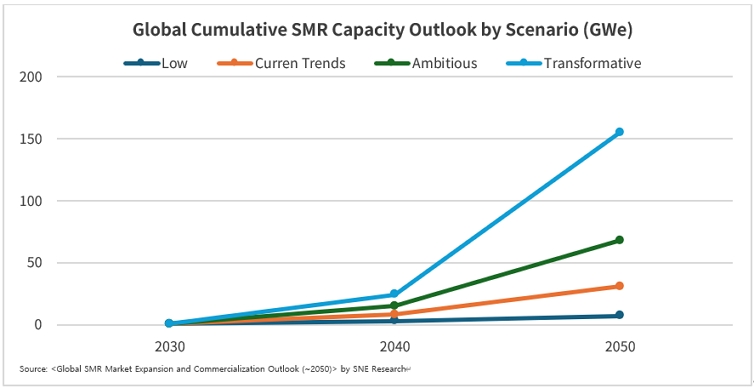
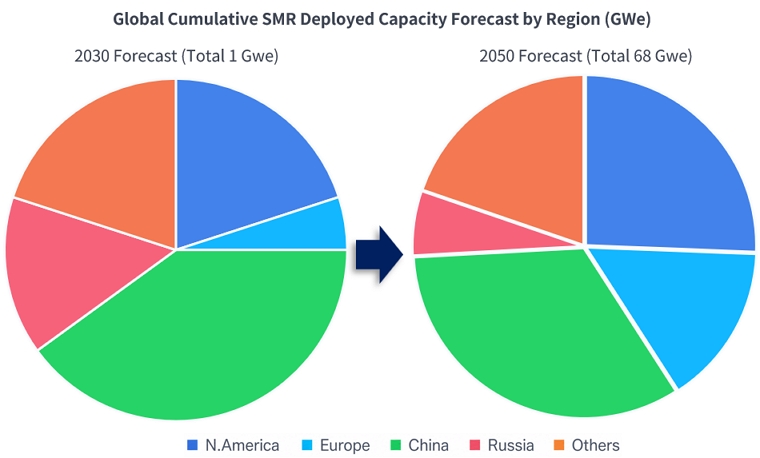
According to analysis by SNE Research, the global cumulative SMR deployed capacity is projected to expand to between approximately 31 GWe and 155 GWe by 2050, depending on the scenario. The market is expected to initially form around early-mover projects in countries such as China and Russia, subsequently expanding its deployment footprint to North America, Europe, and newcomer nuclear nations. By reactor type, Light-Water Reactors (LWRs)—which leverage existing nuclear technology and established supply chains—are anticipated to dominate the early market. Over the medium-to-long term, as non-LWR designs including High-Temperature Gas-cooled Reactors (HTGR), Sodium-cooled Fast Reactors (SFR), and Molten Salt Reactors (MSR) achieve commercialization, the technology portfolio is expected to progressively diversify.
Source:
However, the growth of the
SMR market cannot be determined by technological development alone. To lower
the high initial construction costs and investment risks associated with
early-stage projects, several factors must proceed in parallel: the establishment
of standardized designs and licensing frameworks, the acquisition of
construction and operational track records through First-of-a-Kind (FOAK)
units, cost reductions via repeated deployments, the construction of a stable
supply chain for nuclear fuel and equipment, and the implementation of
long-term Power Purchase Agreements (PPAs) alongside structured financing
mechanisms. Particularly for next-generation non-LWR designs, as the required
nuclear fuels and associated manufacturing and processing supply chains vary by
reactor type, the maturity of the fuel supply ecosystem is also highly likely
to serve as a key variable determining the pace of future commercialization.
Going forward, the global SMR market is expected to shift from a pure technological race to a competition centered on commercialization and project execution capabilities. Demonstration projects, regulatory reforms, and supply chain establishment outcomes across various nations in the 2030s will likely determine the speed of market expansion post-2040. Furthermore, if SMR deployment expands beyond power generation into diverse applications, such as data centers, industrial heat supply, distributed power, and integration with renewable energy sources, the market’s long-term growth potential will broaden even further.