

From Jan to June 2026, Global Electric Vehicle Battery Electrolyte Installment Reached 768K ton, a 22.5% YoY Growth
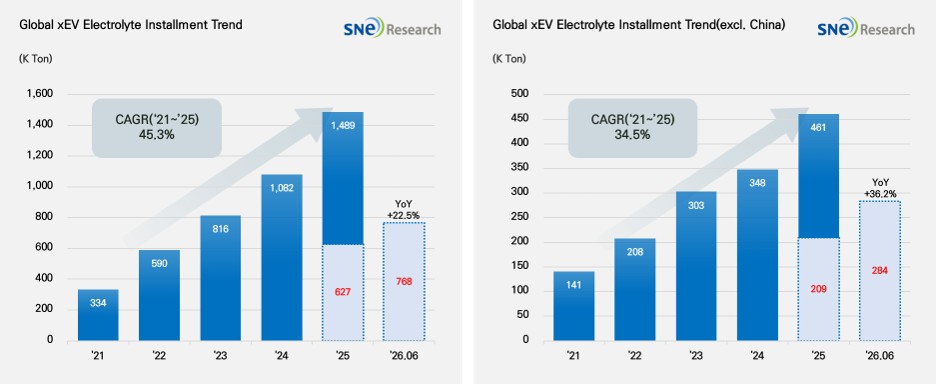
- From Jan to June 2026, the installment of electrolyte outside China reached 284K ton, a 36.2% YoY growth.
(Source: 2026 July Global EV & Battery Monthly Tracker (Incl. LiB 4 Major Materials), SNE Research)
During the first half of 2026, total electrolyte deployment for electric vehicles (including BEVs, PHEVs, and HEVs) registered worldwide reached approximately 768K tons, representing a 22.5% increase year-over-year. Over the same period, electrolyte deployment in the market excluding China recorded approximately 284K tons, surging 36.2% year-over-year and outpacing the overall market growth rate.
As a core material within lithium-ion batteries, the electrolyte facilitates the smooth movement of lithium ions between the cathode and anode. It directly dictates battery charging performance, power output, energy efficiency, cycle life, and stability, with variations in battery performance arising from the combination of electrolyte salts, solvents, and additives. As demands for higher voltage, fast-charging capabilities, low-temperature performance, and extended battery life increase in EV batteries, material formulation design and additive technology competitiveness in electrolytes are becoming increasingly vital.
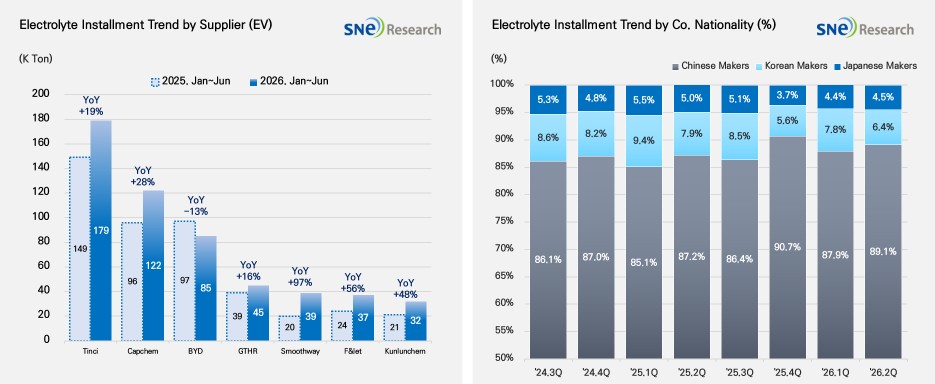
During the first half of 2026, growth momentum across major suppliers in the global electrolyte market diverged. Tinci maintained its top market position, recording approximately 179K tons with a 19% increase year-over-year, while Capchem grew 28% to approximately 122K tons. Conversely, BYD recorded approximately 85K tons, a 13% decline year-over-year. Meanwhile, suppliers including GTHR (+16%), Smoothway (+97%), F&let (+56%), and Kunlunchem (+48%) posted strong growth rates, continuing their expansion in market share.
By corporate nationality, Chinese companies maintained market dominance, accounting for nearly 90% of total deployment. As of the second quarter of 2026, Chinese manufacturers held an 89.1% market share, up 1.1 percentage points from 87.2% in the same period last year. Over the same timeframe, South Korean manufacturers declined from 7.8% to 6.4%, while Japanese manufacturers fell from 5.0% to 4.5%. This underscores the strengthening supply dominance of Chinese players in the electrolyte market, alongside the contracting relative standing of South Korean and Japanese manufacturers.
(Source: 2026 July Global EV & Battery Monthly Tracker (Incl. LiB 4 Major Materials), SNE Research)
During the first half of 2026, the global electrolyte market sustained a robust growth trajectory, propelled by increasing battery deployment for electric vehicles. In particular, the growth rate in the market excluding China significantly outpaced the overall global average, with expanding demand across North America, Europe, and Non-China Asia underpinning overall market expansion.
In the current electrolyte market, Energy Storage Systems (ESS) are emerging as a new growth pillar alongside EV demand. In July, momentum continued with supply agreements for ESS electrolytes utilizing local North American manufacturing hubs, as well as expanding supply footprints targeting ESS markets in China and North America. Consequently, securing local manufacturing networks and maintaining utilization rates for existing facilities have surfaced as critical components of competitiveness. Concurrently, as high-voltage and fast-charging batteries see wider adoption, product differentiation is shifting toward formulation design combining electrolyte salts—such as 〖"LiPF" 〗_6 and "LiFSI" —with functional additives, along with technical responsiveness in thermal stability, low-temperature performance, and extended cycle life. Looking ahead, while Chinese suppliers maintain their cost and scale dominance, market standings among individual suppliers will be dictated by local manufacturing footprints across North America and Europe, raw material sourcing stability, customized additive technologies, and responsiveness to high-functionality electrolytes for ESS.