

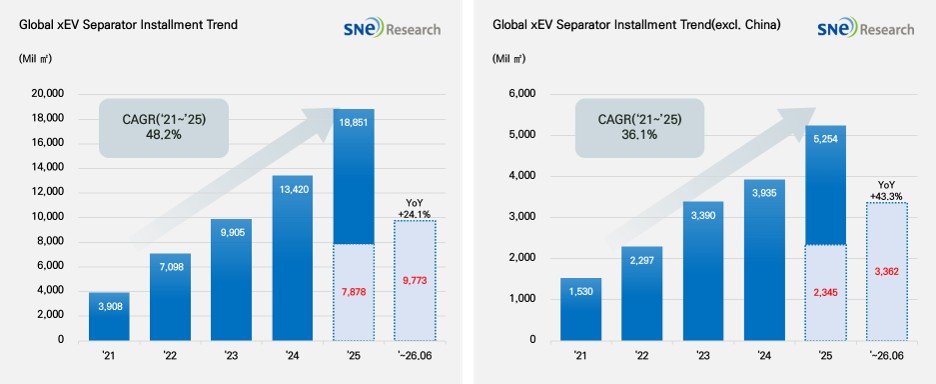
From Jan to June 2026, Global EV Battery Separator Installment Reached 9,773Mil ㎡, a 24.1% YoY Growth
- Chinese Separator Manufacturers Capture 91.5% Market Share in Q2 2026, Deepening China-Centric Dominance in Global Supply Structures
(Source: 2026 July Global EV & Battery Monthly Tracker (Incl. LiB 4 Major Materials), SNE Research)
During the first half of 2026, total battery separator deployment for electric vehicles (including BEVs, PHEVs, and HEVs) registered worldwide reached approximately 9,773 million square meters (Mil ㎡), representing a 24.1% increase year-over-year. Over the same period, separator deployment in the global market excluding China totaled approximately 3,362 Mil ㎡, surging 43.3% year-over-year and outperforming the overall market growth rate.
As a core material within lithium-ion batteries, the separator physically isolates the cathode and anode to prevent short circuits while providing migration pathways for lithium ions. It directly dictates battery safety, power output performance, and cycle life, experiencing steady demand expansion driven by EV market proliferation, increasing battery capacity per vehicle, and the expanding adoption of high-energy-density and fast-charging cells.
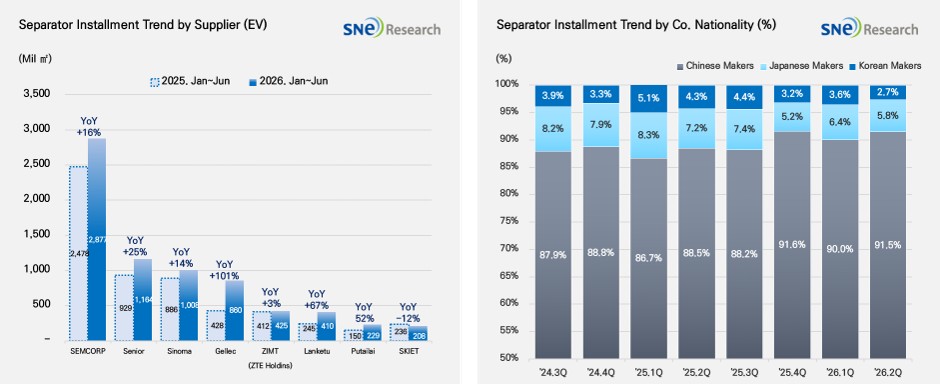
During the first half of 2026, growth trajectories across major suppliers in the global separator market diverged sharply. SEMCORP maintained its leading position, recording approximately 2,877 Mil ㎡ with a 16% increase year-over-year, while Senior (+25%) and Sinoma (+14%) sustained double-digit growth. Notably, Gellec (+101%), Lanketu (+67%), and Putailai (+62%) logged exceptionally high growth rates, rapidly scaling their supply volumes. Conversely, ZIMT (ZTE Holdings, +3%) stayed largely flat compared to the previous year, while SK IE Technology (-12%) recorded a contraction among key players.
By corporate nationality, Chinese suppliers captured a dominant 91.5% market share as of the second quarter of 2026, accounting for the vast majority of the global separator market. Japanese and South Korean suppliers logged market shares of 5.8% and 2.7%, respectively. While the market share of Chinese players rose by 3.0 percentage points from 88.5% in Q2 2025, Japanese manufacturers declined from 7.2% to 5.8%, and Korean manufacturers fell from 4.3% to 2.7% over the same period. Amid the strengthening scale and cost competitiveness of Chinese suppliers, the relative standing of Japanese and South Korean manufacturers continues to contract.
(Source: 2026 July Global EV & Battery Monthly Tracker (Incl. LiB 4 Major Materials), SNE Research)
During the first half of 2026, the global EV separator market sustained a robust expansion trajectory, driven by increasing battery capacities per vehicle and rapid growth in markets outside China. In China, expanded battery cell manufacturing and an LFP-centric chemistry mix supported separator demand. In the non-Chinese market, volume growth was propelled by expanding EV sales across Europe and Non-China Asia, new model rollouts, and higher battery capacities per vehicle. However, as selected automakers continued to adjust EV production pacing, particularly in North America, growth performance gaps across suppliers widened further depending on client mix and regional supply structures.
In the current separator market, despite demand expansion, ample supply capacity for commodity products has prolonged price competition, with July prices in China for key dry, wet, and coated separators remaining largely flat month-over-month. Consequently, rather than simple volume expansion, yield optimization, cost control, and responsiveness to high-value-added products, such as ceramic-coated, high-heat-resistant, and ultra-thin separators, are emerging as critical variables shaping profitability. Concurrently, as battery demand expands for ESS and data center applications, and as the EU's digital product registration system for the Battery Passport takes concrete shape, supply chain data management and traceability compliance are gaining strategic importance even at the material level. Looking ahead, competitive standings among suppliers will be dictated by EV and ESS client diversification, technical capabilities in high-performance products, local supply networks across North America and Europe, and the ability to mitigate dependency on China.