

From Jan to June 2026, Non-Chinese Global[1] EV Battery Usage[2] Posted 269.0GWh, a 26.3% YoY Growth
-
CATL and BYD capture 44.1% combined shares, expanding the influence of Chinese players
in non-China markets.
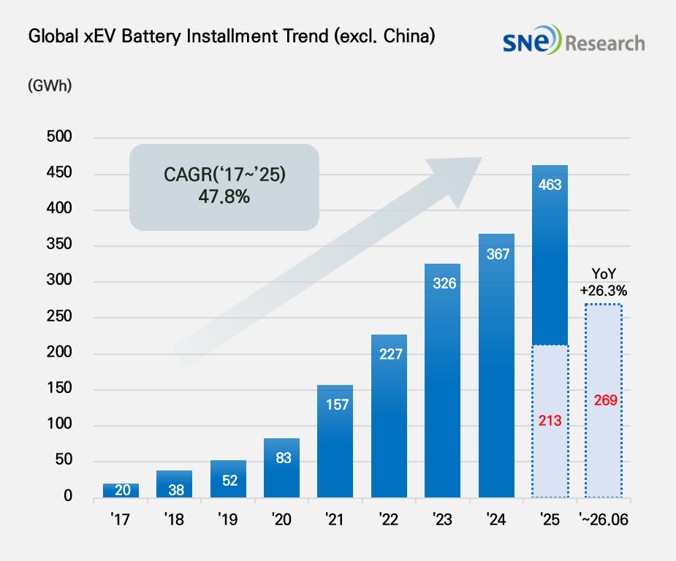
During the first half of 2026, total battery usage deployed in electric vehicles (including BEVs, PHEVs, and HEVs) in the global market excluding China reached approximately 269.0 GWh, marking a 26.3% increase year-over-year.
(Source: Global EV and Battery Monthly Tracker – July 2026, SNE Research)
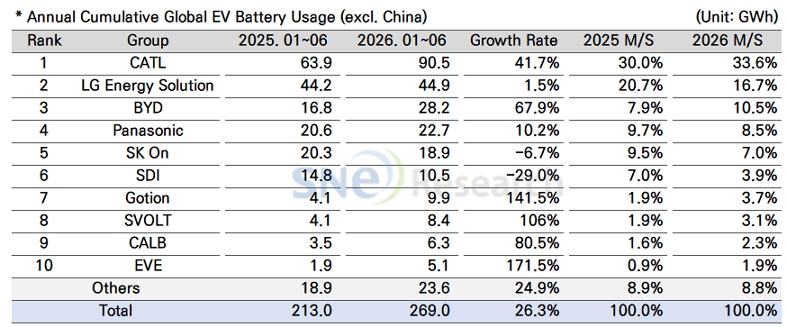
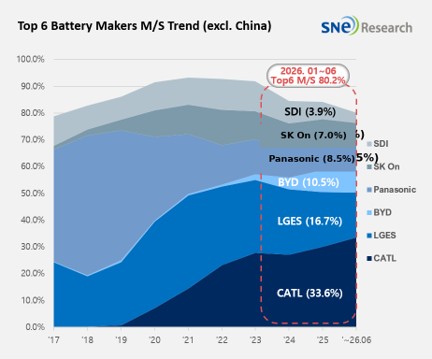
In the same period, combined battery usage from South Korea’s three major battery manufacturers—LG Energy Solution, SK On, and Samsung SDI—in the non-Chinese EV market totaled 74.3 GWh, representing a 6.3% decline year-over-year. Consequently, their combined market share contracted by 9.6 percentage points from 37.2% to 27.6% compared to the same period last year.
By company, LG Energy Solution posted 44.9 GWh, a modest 1.5% increase year-over-year; however, trailing the overall market growth rate, its market share fell from 20.7% to 16.7%. SK On logged 18.9 GWh, down 6.7%, while Samsung SDI recorded 10.5 GWh, a 29.0% decline. As the non-Chinese market sustained double-digit expansion while the Korean trio experienced declining volumes, the growth trajectory gap between Korean and Chinese manufacturers widened further.
(Source: Global EV and Battery Monthly Tracker – July 2026, SNE Research)
LG Energy Solution retained its second-place standing in the non-Chinese market by delivering 44.9 GWh, a 1.5% increase year-over-year. The company sustained battery supply to major global OEMs, including Tesla, GM, Hyundai Motor Group, and Volkswagen, with sales growth at select client OEMs contributing to the volume expansion. However, falling significantly short of the overall non-Chinese market growth rate of 26.3%, its market share contracted by 4.0 percentage points from 20.7% to 16.7%. Amid the expanding overseas supply and rising LFP adoption among Chinese manufacturers, enhancing local production efficiency in North America and Europe alongside diversifying client and product portfolios are projected to be critical for future market share recovery.
SK On posted 18.9 GWh in battery deployment, representing a 6.7% decline year-over-year, which pushed its market share down from 9.5% to 7.0%. SK On supplies batteries to major automakers including Hyundai Motor Group, Ford, Volkswagen, and Mercedes-Benz. While select new EV models from Hyundai Motor Group bolstered its performance, this was insufficient to offset sales slowdowns and production schedule adjustments among key client OEMs in North America and Europe. In particular, as demand volatility in the North American EV market and production pacing by automakers persisted, deployment volume fluctuations heightened in tandem with individual client sales trends.
Samsung SDI recorded 10.5 GWh, a 29.0% decline year-over-year, marking the steepest contraction among top-tier manufacturers. Consequently, its market share shrank from 7.0% to 3.9%. While maintaining battery supply to major clients such as BMW, Audi, and Rivian, sluggish sales at Rivian—which has high exposure to North America—and decelerating demand for existing electrified models among key European clients directly pulled down deployment volumes. Although partial gains from new model rollouts materialized, they were insufficient to offset the decline in primary flagship models.
Panasonic placed fourth with 22.7 GWh, representing a 10.2% increase year-over-year. Battery deployment expanded primarily around North American production vehicles for its key client, Tesla; however, trailing the broader non-Chinese market growth rate, its market share dropped from 9.7% to 8.5%. While preserving its Tesla-centric supply structure, Panasonic is advancing mass production of next-generation cylindrical batteries and driving operational efficiency improvements across North America. Nevertheless, given its high client concentration, shifts in Tesla's regional sales and production strategies are projected to serve as primary variables shaping future performance.
CATL retained its top position in the global market excluding China during the first half (January–June) of 2026, logging 90.5 GWh—a 41.7% surge year-over-year. Its market share rose by 3.6 percentage points from 30.0% to 33.6%. Outside China, CATL expanded supplies to global OEMs including Tesla, BMW, Mercedes-Benz, Toyota, and Kia. Securing both Chinese automakers and global OEMs as dual client bases across major regions like Europe and Asia acted as the primary catalyst driving its growth. Furthermore, cost competitiveness centered on LFP chemistry and a broad product portfolio continue to fortify its expanding footprint in the non-Chinese market.
Emerging Chinese battery manufacturers—including Gotion, SVOLT, CALB, and EVE—also demonstrated remarkable growth. Gotion logged 9.9 GWh, a 141.5% surge year-over-year, while SVOLT grew 106.0% to 8.4 GWh, and CALB expanded 80.5% to 6.3 GWh. EVE posted the highest growth rate among peers at 171.5%, reaching 5.1 GWh. Alongside the overseas sales expansion of Chinese automakers, these companies are broadening supply opportunities to global OEMs across Europe, Asia, and emerging markets. Leveraged by cost-competitive LFP products and localized production and partnership strategies, they are rapidly scaling their supply footprints in the non-Chinese market.
BYD secured third place with 28.2 GWh, representing a 67.9% increase year-over-year. Its market share rose by 2.6 percentage points from 7.9% to 10.5%. Expanding overseas vehicle sales from its proprietary EV lineup spearheaded this deployment growth, bolstered by the price competitiveness and safety profile of its Blade Battery. Pivoting away from a China-centric business model, BYD is broadening its vehicle distribution networks and production hubs across Europe, Asia, and Latin America—positioning its battery deployment in the non-Chinese market to sustain a strong upward trajectory for the foreseeable future.
(Source: Global EV and Battery Monthly Tracker – July 2026, SNE Research)
During the first half of 2026, the secondary battery market for electric vehicles in the global market excluding China sustained a robust expansion trajectory, growing 26.3% year-over-year. However, performance diverged sharply across individual manufacturers. While market shares for South Korea's three major battery makers and Panasonic contracted, Chinese players—led by CATL and BYD—amplified their influence in the non-Chinese market, propelled by expanded supplies to global OEMs, overseas penetration by Chinese automakers, and LFP-based cost competitiveness. Notably, with growth rates for Chinese manufacturers among the top ten significantly outpacing the market average, the restructuring of the supply landscape is accelerating even within non-Chinese regions.
Looking ahead, regional demand trajectories and supply chain regulatory frameworks are projected to shape competitive standings among manufacturers. In Europe, alongside expanding EV adoption and sustained penetration by Chinese players, a digital registration system for the implementation of the Battery Passport entered operational phases in July, elevating the strategic importance of supply chain traceability and localized response capabilities. In North America, amid persistent policy uncertainties and production pacing by automakers, optimizing local manufacturing efficiency and securing non-Chinese supply chains are emerging as core imperatives. Consequently, in the upcoming market landscape, a manufacturer's standing will be dictated not only by price competitiveness, but also by regional manufacturing hubs, long-term supply partnerships with global OEMs, responsiveness in LFP and next-generation battery chemistries, and supply chain data management capabilities.
[1] The xEV sales of 80
countries are aggregated. (excl. the China market)
[2] Based on battery installation for xEV registered during the relevant period.