

Global FCEV Sales Reach 4,643 Units in H1 2026, Up 13.0% YoY
- Hyundai retains dominant lead with 71.9% market share (3,337 units), while Chinese commercial FCEV sales drop 54.4%
During the first half of 2026, global sales of fuel cell electric vehicles (FCEVs) reached 4,643 units, marking a 13.0% increase year-over-year compared to the 4,110 units recorded in the same period last year. However, as the majority of this growth was driven by South Korea’s new NEXO model, sales of Chinese commercial fuel cell vehicles alongside those of Toyota and Honda declined—sharpening the divergence across regions and manufacturers.
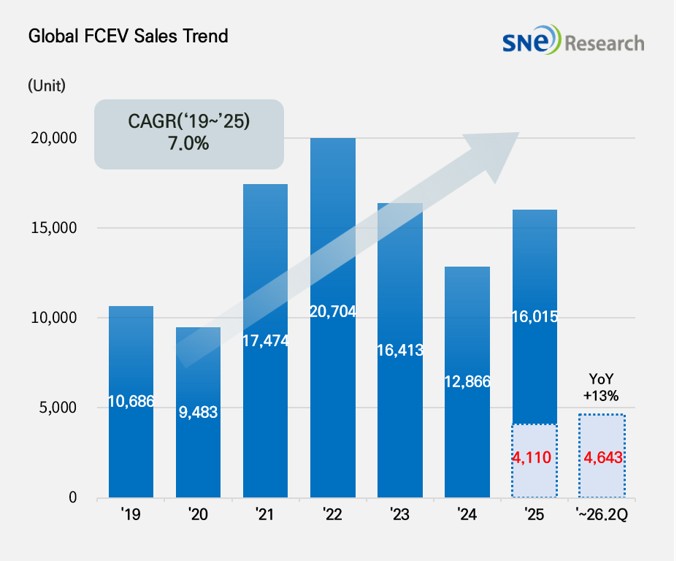
(Source: Global FCEV Monthly Tracker – July 2026, SNE Research)
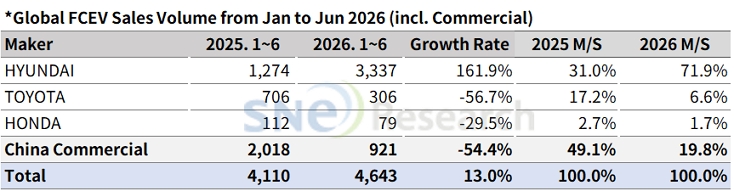
By manufacturer, Hyundai Motor retained a dominant lead at the top spot by delivering 3,337 units, primarily centered on the NEXO, marking a 161.9% surge year-over-year. Consequently, its market share skyrocketed from 31.0% to 71.9%. Strong domestic sales of the second-generation NEXO launched in 2025 acted as the primary catalyst driving this growth. Hyundai is constructing dedicated fuel cell production facilities in Ulsan, expanding its business scope beyond passenger vehicles to encompass XCIENT fuel cell trucks as well as stationary power generation and industrial applications.
Conversely, Toyota recorded 306 units across its Mirai and Crown models, representing a 56.7% decline year-over-year, which pushed its market share down from 17.2% to 6.6%. As inadequate charging infrastructure and constrained sales regions continue to cap demand for passenger FCEVs, Toyota continues its joint development of next-generation fuel cell systems alongside BMW. Similarly, Honda posted modest sales of just 79 units for the CR-V e:FCEV (-29.5%). Nevertheless, Honda is preparing for mass production of its proprietary next-generation fuel cell module in fiscal year 2027—succeeding its current co-developed architecture with GM—while broadening application domains into commercial vehicles and power generation. Meanwhile, Chinese commercial vehicle manufacturers logged 921 units, a 54.4% drop year-over-year. This sharp contraction is attributed to pre-orders fulfilled ahead of the conclusion of pilot city demonstration programs in late 2025, creating a temporary sales cliff during the first half of the year prior to the implementation of follow-up policy measures.
(Source: Global FCEV Monthly Tracker – July 2026, SNE Research)
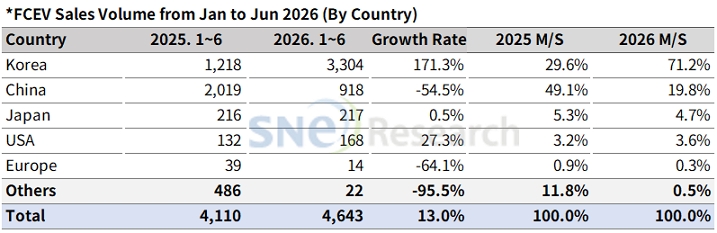
By country, South Korea captured the top position with 3,304 units, a 171.3% surge year-over-year, accounting for a 71.2% market share. Expanding sales of the new NEXO effectively spearheaded the global market’s rebound. Conversely, China recorded 918 units, a 54.5% decline, which shrank its market share from 49.1% to 19.8%. The new comprehensive hydrogen application demonstration program announced in March 2026 focuses on expanding through 2030 across five major city clusters, targeting commercial vehicle operations—such as heavy-duty, long-haul transport, and refrigerated logistics—integrated with industrial hydrogen supply. Japan remained flat at 217 units (+0.5%), while the United States saw a modest recovery to 168 units (+27.3%). Europe continued to log the steepest decline, dropping to 14 units (-64.1%). Although the EU Alternative Fuels Infrastructure Regulation (AFIR) mandates the deployment of hydrogen refueling stations at maximum intervals of 200 km along the TEN-T core network by 2030, low vehicle adoption rates and high operational costs at present continue to constrain market expansion.
(Source: Global FCEV Monthly Tracker – July 2026, SNE Research)
The 13.0% growth in the global FCEV market during the first half of 2026 represented a selective rebound driven predominantly by South Korean demand centered on the new NEXO. Excluding South Korea and the United States, sales across China, Europe, Toyota, and Honda all declined, indicating that the market base has not broadened. Notably, despite China's 54.5% drop in H1 sales following pre-orders fulfilled in late 2025, the country is pushing for a re-expansion centered on heavy-duty logistics with a target of 100,000 fuel cell vehicles by 2030 via its new March demonstration project. Europe is also sustaining mid-to-long-term investments, supported by AFIR refueling network mandates and BMW’s plans for series production of hydrogen vehicles starting in 2028. Consequently, the market trajectory in the second half hinges on the sales continuity of the new NEXO, the execution speed of China’s new demonstration initiatives, and improvements in hydrogen fuel pricing and station utilization rates. Moving forward, the FCEV sector is more likely to grow by complementing battery electric vehicles (BEVs) in long-haul, heavy-duty, and high-utilization commercial transport rather than in mainstream passenger vehicle mass adoption.