

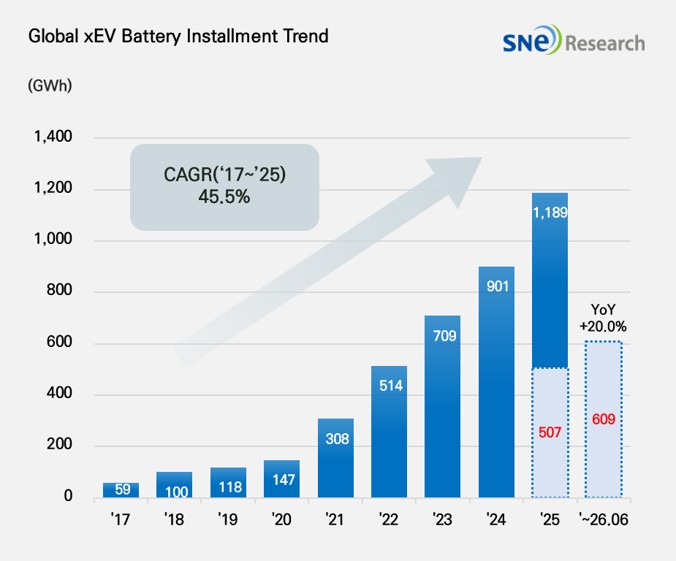
From Jan to June 2026, Global[1] EV Battery Usage[2] Posted 608.5GWh, a 20.0% YoY Growth
- Among the
top 10 rankers, 7 Chinese battery makers accounted for 72.4%, a 1.5%p YoY
increase
From Jan to
June 2026, the amount of energy held by batteries
for electric vehicles (EV, PHEV, HEV) registered worldwide was approximately 608.5GWh,
a 20.0% YoY growth.
(Source: 2026 July Global Monthly EV and Battery Monthly Tracker, SNE Research)
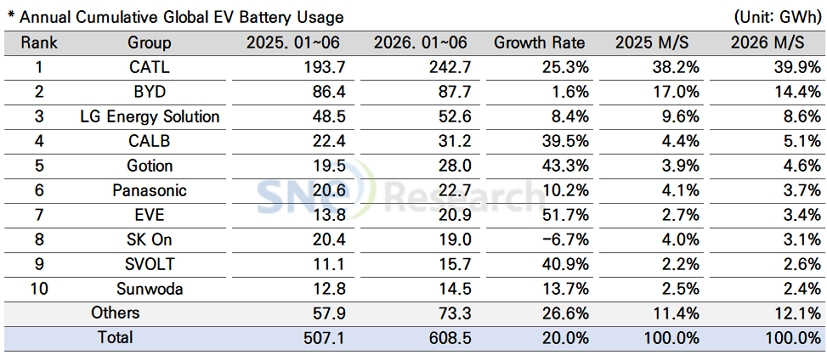
In the global electric vehicle (EV) battery market during the first half (January–June) of 2026, CATL defended its leading position by delivering 242.7 GWh, marking a 25.3% increase year-over-year. Its market share climbed by 1.7 percentage points from 38.2% to 39.9%. BYD retained the second spot with 87.7 GWh, a modest 1.6% increase compared to the same period last year, capturing a 14.4% market share. Together, CATL and BYD commanded a combined market share of 54.3%, accounting for more than half of the entire global EV battery arena.
(Source: 2026 July Global Monthly EV and Battery Monthly Tracker, SNE Research)
Among South Korean manufacturers, LG Energy Solution retained its third-place standing by recording 52.6 GWh, an 8.4% increase year-over-year. While its deployment volume expanded on the back of sustained supply to major global OEMs—including Tesla, Hyundai Motor Group, GM, and Volkswagen—its growth pace lagged behind the broader market average. Consequently, its market share slipped by 1.0 percentage point, falling from 9.6% to 8.6% compared to the same period last year. This trend indicates that despite volume expansion, the battery maker faced limitations in defending its market share due to a confluence of rapid physical expansion by Chinese competitors and diverging EV sales performance across its customer base.
SK On recorded 19.0 GWh, marking a 6.7% decline year-over-year, which caused its market share to contract from 4.0% to 3.1%. SK On’s batteries are installed in vehicles from major automakers, including Hyundai Motor Group, Ford, Volkswagen, and Mercedes-Benz. However, the recovery of its deployment volume was capped by ongoing EV sales and production schedule adjustments among select clients in North America and Europe. Amid high client-side sales volatility, stabilizing operations at its North American production hubs and expanding supply to new vehicle models are projected to emerge as key variables driving future performance recovery.
Japanese supplier Panasonic ranked sixth by recording 22.7 GWh, a 10.2% increase year-over-year. While sales momentum from its key client, Tesla, in North America contributed to the uptick in deployment volume, its growth rate trailed the market average, pushing its market share down from 4.1% to 3.7%. While maintaining a Tesla-centric supply architecture, Panasonic is actively pursuing operational efficiency improvements in North America alongside securing mass-production capabilities for next-generation cylindrical batteries. Moving forward, the stable ramp-up of new production capacity and the diversification of its client portfolio are projected to determine the recovery of its market share.
Chinese battery manufacturers sustained robust growth across top-tier rankings, anchored by CATL. CALB retained its fourth-place standing by reaching 31.2 GWh, a 39.5% increase year-over-year, while Gotion captured fifth place with 28.0 GWh, representing a 43.3% surge. EVE logged 20.9 GWh, marking a 51.7% increase, and SVOLT expanded 40.9% to reach 15.7 GWh. Sunwoda also advanced to 14.5 GWh, up 13.7% year-over-year. The combined market share of these five companies, alongside CATL and BYD, reached 72.4% among the seven major Chinese suppliers, marking a 1.5 percentage point increase compared to the same period last year. This expansion is attributed to leveraging their domestic client base and LFP-driven cost competitiveness to scale up volumes, while simultaneously broadening their supply footprint into overseas OEMs and commercial vehicle segments.
BYD retained the second spot globally by delivering 87.7 GWh, a modest 1.6% increase year-over-year. Although its deployment volume expanded slightly, its growth pace fell significantly short of the market average, causing its market share to decline by 2.6 percentage points from 17.0% to 14.4%. This performance reflects a corporate structure heavily influenced by sales trends of its own electric vehicles within the domestic Chinese market. However, BYD is actively expanding its brand sales network and localized production footprints in overseas markets while strengthening product competitiveness around its Blade Battery and fast-charging technologies. Consequently, whether it can successfully scale up deployment volumes in non-Chinese markets is projected to emerge as a critical determinant moving forward.
(Source: 2026 July Global Monthly EV and Battery Monthly Tracker, SNE Research)
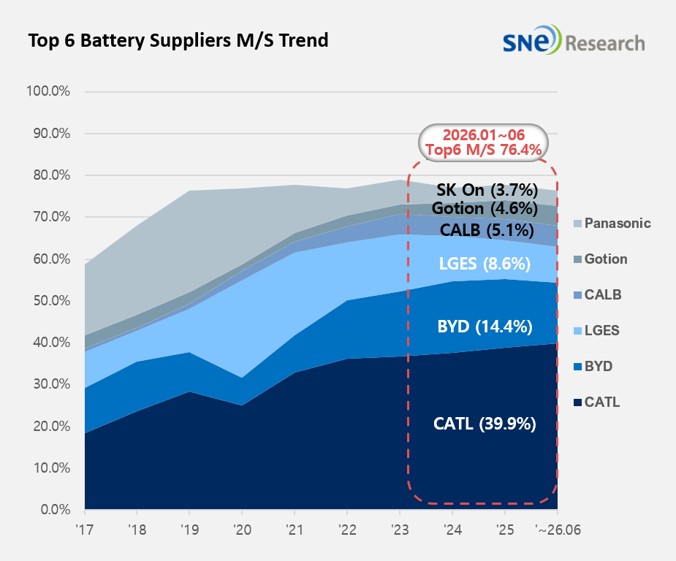
During the first half of 2026, the global electric vehicle (EV) secondary battery market expanded by 20% year-over-year, yet the center of growth tilted even further toward CATL and mid-tier Chinese manufacturers. Leveraged by domestic market scale, LFP-driven cost competitiveness, and agile product turnarounds, Chinese players widened their market share. Conversely, South Korean and Japanese manufacturers recorded relatively subdued growth rates, impacted by regional sales and production schedule adjustments among their primary clients.
Recently, alongside persistent policy and demand uncertainties in North America, requirements for localization and supply chain traceability are escalating in Europe—as evidenced by the concrete preparations for digital registration frameworks and supply chain data management aimed at implementing the EU Battery Passport. Consequently, future competitiveness in the global battery market is projected to hinge not merely on simple production scale, but on operational efficiency across regional manufacturing hubs, client portfolio diversification, strategic product mix adaptation (including LFP and next-generation cylindrical form factors), and regulatory compliance capabilities across global supply chains.
[2] Based on battery installation for xEV registered during the relevant period.