

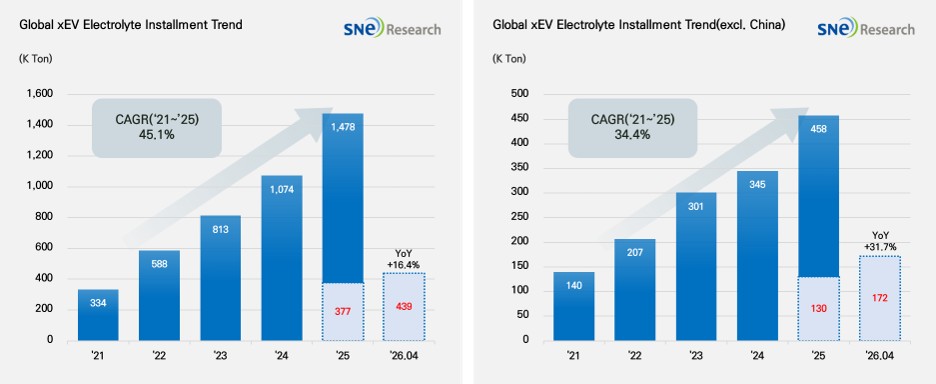
From Jan to Apr 2026, Global[1] Electric Vehicle Battery Electrolyte Installment[2] Reached 439K ton, a 16.4% YoY Growth
- From Jan to Apr
2026, the installment of electrolyte outside China reached 172k ton, a 31.7% YoY growth.
(Source: 2026 May Global EV & Battery Monthly Tracker (Incl. LiB 4 Major Materials), SNE Research)
From January to April 2026, the global installation volume of electrolytes for electric vehicles (EV, PHEV, HEV) registered worldwide reached approximately 439K tons, marking a 16.4% growth year-on-year. During the same period, the market excluding China recorded approximately 172K tons, increasing by 31.7% compared to the previous year and demonstrating a relatively high growth trajectory.
The electrolyte is a core material within lithium-ion batteries that enables lithium ions to move between the anode and cathode. It directly impacts a battery's charging performance, power output, energy efficiency, lifespan, and stability, with variations in performance stemming from the combination of electrolyte salts, solvents, and additives. As demand expands for higher voltage, fast-charging capabilities, and improved low-temperature performance in EV batteries, the competitiveness of electrolyte material design and additive technology is becoming increasingly critical.
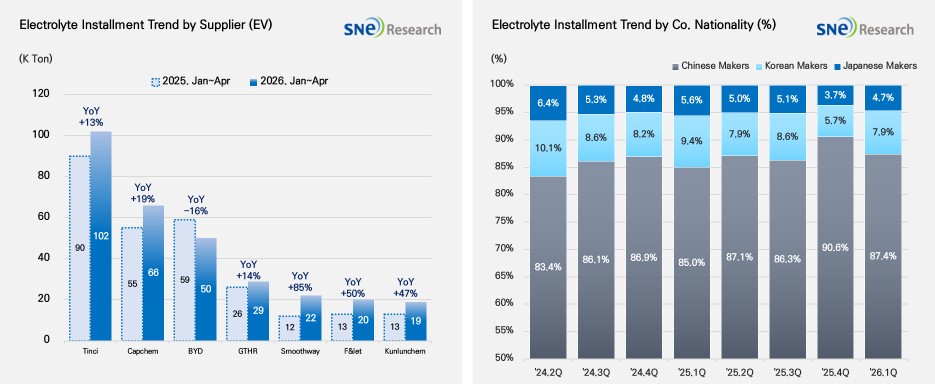
From January to April 2026, the global electrolyte market witnessed divergent trends among major suppliers. Tinci recorded approximately 102K tons, growing 13% year-on-year to maintain its top position in the market, while Capchem rose 19% to approximately 66K tons. Conversely, BYD recorded approximately 50K tons, a 16% year-on-year decrease, making it the only major manufacturer to post a decline. Meanwhile, suppliers such as GTHR (+14%), Smoothway (+85%), F&let (+50%), and Kunlunchem (+47%) logged high growth rates, signaling a push to expand their market shares.
In terms of market share by corporate nationality, Chinese companies maintained their market dominance, commanding roughly 90% of the total volume. As of the first quarter of 2026, the share of Chinese firms stood at approximately 87.4%, dipping compared to the previous quarter (90.6%) but representing a 2.4 percentage point increase compared to the same period last year (85.0%). Concurrently, South Korean and Japanese peers lingered at approximately 7.9% and 4.7%, respectively. This underscores that the China-centric supply structure is reinforcing its grip on the electrolyte market.
(Source: 2026 May Global EV & Battery Monthly Tracker (Incl. LiB 4 Major Materials), SNE Research)
The global electrolyte market continues its robust growth trajectory, driven by the increasing installation volume of EV batteries. Notably, the growth rate of the market excluding China significantly outperforms the overall market average, with demand expansion centered on North America, Europe, and non-China Asian regions driving the upward trend.
Currently, the electrolyte market is entering a phase where raw material price volatility, supply chain localization, and technological competition for high-value additives are taking place simultaneously, moving beyond a simple volume expansion. Amid expanding price volatility for core electrolyte salts such as LiPF6, major suppliers are moving to defend profitability through raw material procurement stability and in-house production. Concurrently, as demand rises for high-voltage batteries, fast-charging optimization, low-temperature performance improvements, and long-life ESS batteries, additive design capabilities and customized electrolyte development skills are emerging as core competitive variables. Consequently, while the volume dominance of Chinese suppliers is projected to persist in the global electrolyte market moving forward, a manufacturer's ultimate market standing will be dictated by securing local production bases in North America and Europe, diversifying non-China supply chains, and its responsiveness to high-functional electrolytes for ESS and next-generation batteries.
[2] Based on batteries installed to electric vehicles registered during the relevant period.