

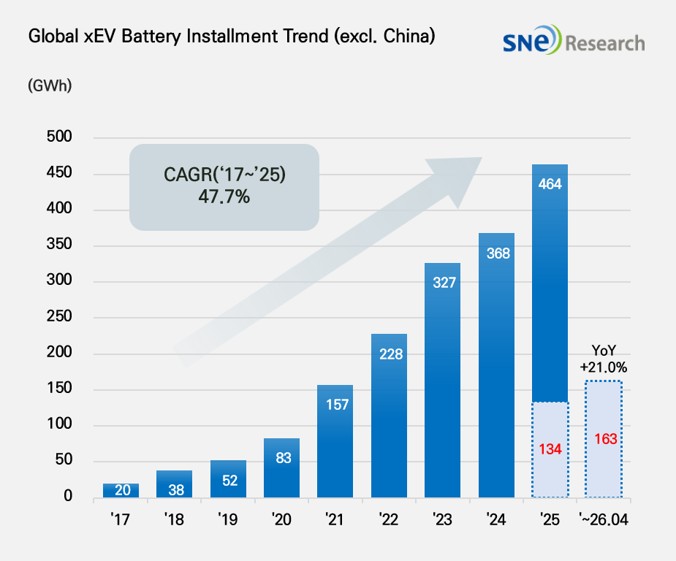
From Jan to Apr 2026, Non-Chinese Global[1] EV Battery Usage[2] Posted 162.7GWh, a 21.0% YoY Growth
-
CATL and BYD Capture 44.2% Combined Share, Expanding Influence of Chinese
Players in Non-China Markets
Battery installation for global
electric vehicles (EV, PHEV, HEV) excluding the Chinese market sold from Jan to
Apr 2026 was approximately 162.7GWh, a 21.0% YoY growth.
(Source: Global EV and Battery Monthly Tracker – May 2026, SNE Research)
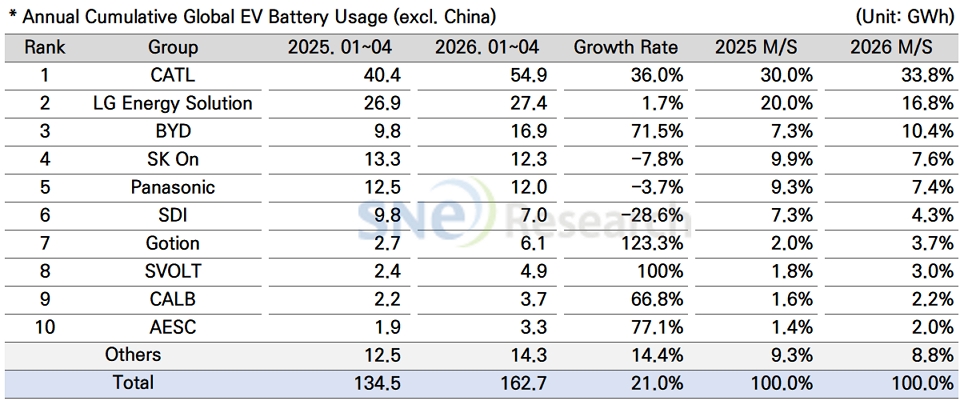
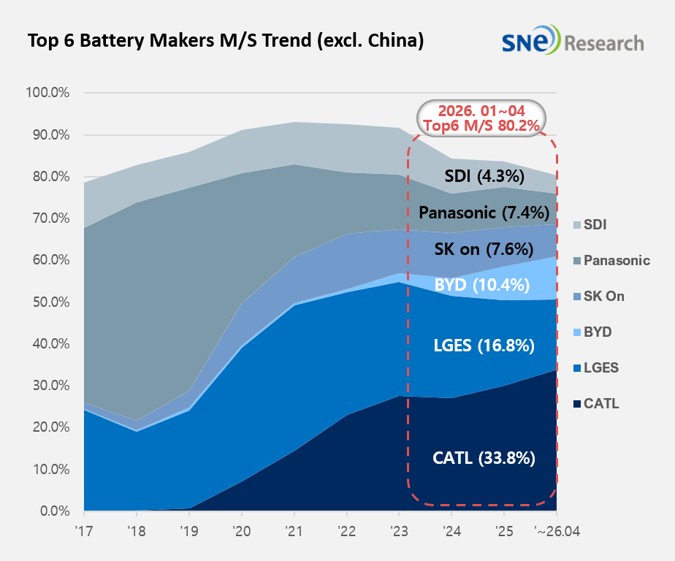
From January to April 2026, the combined market share of South Korea’s top three battery makers—LG Energy Solution, SK on, and Samsung SDI—in the global EV battery market (excluding China) stood at 28.7%, down 8.5 percentage points year-on-year. LG Energy Solution recorded 27.4 GWh, a 1.7% increase compared to the same period last year; however, as its growth trailed the market average, its market share fell from 20.0% to 16.8%. SK On registered 12.3 GWh, marking a 7.8% decrease, while Samsung SDI posted 7.0 GWh, a 28.6% decline. While the overall non-China market expanded by 21.0%, the combined usage volume of the three Korean manufacturers contracted year-on-year, underscoring the increasingly prominent market share expansion of Chinese battery competitors.
(Source: Global EV and Battery Monthly Tracker – May 2026, SNE Research)
Looking at the battery usage of the three South Korean manufacturers by automaker client, Samsung SDI supplies batteries centered on major customers such as BMW, Audi, and Rivian; however, a slowdown in the sales of key electrified models led to a decline in usage. In particular, reflecting the direct impact of falling sales from customers with high exposure to the North American market, such as Rivian, Samsung SDI's market share in the non-China market dropped from 7.3% to 4.3% compared to the same period last year. Despite the launch of some new electric vehicles, sales trends for existing flagship models from BMW and Audi also fell short of expectations, acting as a factor in the reduced installation volume.
SK On's batteries were primarily installed in major automakers including Hyundai Motor Group, Ford, Volkswagen, and Mercedes-Benz. While stable sales of certain EV models from Hyundai Motor Group and the effects of new model rollouts were reflected, slowing EV sales from key clients like Ford and Volkswagen led to a decline in overall usage. Especially as EV demand adjustments and production pacing continued in the North American market, SK On's battery usage decreased by 7.8% year-on-year, with its market share also declining from 9.9% to 7.6%.
LG Energy Solution retained the second position in the non-China market, recording 27.4 GWh. Battery supplies continued seamlessly centered on major global OEMs such as Tesla, GM, Hyundai Motor Group, and Volkswagen, with expanded EV sales from some of these clients contributing to the increase in usage volume. However, as Chinese companies grew at a faster pace within the non-China market, LG Energy Solution's market share declined by 3.2 percentage points year-on-year. This indicates that amid intensifying competition within global OEM supply chains, factors such as price competitiveness, LFP product responsiveness, and the securement of regional production hubs are directly impacting market share shifts.
CATL maintained its top spot in the global market (excluding China) from January to April 2026, recording 54.9 GWh, a 36.0% year-on-year increase. Its market share rose from 30.0% to 33.8%. CATL is rapidly strengthening its presence in the non-China market by expanding supplies to global OEMs including Tesla, BMW, Mercedes-Benz, Toyota, and Kia. The analysis suggests that securing both Chinese automakers and global OEMs as clients in Europe, Asia, and emerging markets driven its upward growth trajectory.
BYD ranked third, recording 16.9 GWh, representing a robust 71.5% year-on-year growth. Its market share also advanced from 7.3% to 10.4%. Breaking away from its previous battery usage structure heavily centered on the Chinese domestic market, the expansion of its own EV sales overseas alongside increased supplies to certain external clients led to its growth in the non-China market. Based on its Blade Battery, BYD is simultaneously emphasizing price competitiveness and safety, and a clear surge in battery usage is accompanying the recent expansion of its EV sales networks in overseas markets.
The growth of late-comer Chinese manufacturers such as Gotion, SVOLT, and CALB was also prominent. Gotion recorded 6.1 GWh, a 123.3% year-on-year growth, while SVOLT registered 4.9 GWh, a 100.0% increase. CALB also grew by 66.8% to reach 3.7 GWh. Along with the expanding overseas advancement of Chinese automakers, these companies are widening their supply opportunities in Europe, Asia, and emerging markets, scaling up their presence in the non-China market through price competitiveness centered on LFP batteries.
Panasonic recorded 12.0 GWh, a 3.7% decrease compared to the same period last year. The analysis indicates that shifting sales trends across different models of its major customer, Tesla, and demand adjustments in the North American market impacted Panasonic's battery usage. While Panasonic still maintains a Tesla-centric supply structure, it is pursuing mid-to-long-term competitiveness through next-generation cylindrical batteries and improvements in North American production efficiency. However, a structure with high customer concentration could act as a performance volatility factor in phases where market volatility increases.
(Source: Global EV and Battery Monthly Tracker – May 2026, SNE Research)
From January to April 2026, the global EV secondary battery market, excluding China, maintained its overall growth trajectory, but the fruits of this growth varied significantly by manufacturer. Despite expanding demand in the non-China market, major established non-Chinese suppliers, including the three South Korean manufacturers and Panasonic, experienced a decline in market share, impacted by slowing sales from key customers in North America and Europe alongside shifting product portfolios. Conversely, Chinese companies, led by CATL and BYD, are rapidly raising their influence in the non-China market, backed by price competitiveness, LFP product competitiveness, and expanded supply to global OEMs.
Currently, the non-China EV battery market is emerging not merely as an alternative market that excludes Chinese domestic influence, but as the core battleground where the actual competitive landscape of global battery manufacturers is being reorganized. In North America, the importance of local production and securing non-Chinese supply chains is growing due to policy shifts and tightened supply chain regulations. Meanwhile, in Europe and emerging markets, the expansion of Chinese companies leveraging price competitiveness and product safety is accelerating. Consequently, in the future non-China battery market, regional production hubs, long-term supply relationships with global OEMs, responsiveness to LFP and next-generation batteries, and the securement of new demand sources such as ESS will act as key variables determining each manufacturer's market position.
[2] Based on battery installation for xEV registered during the relevant period.