

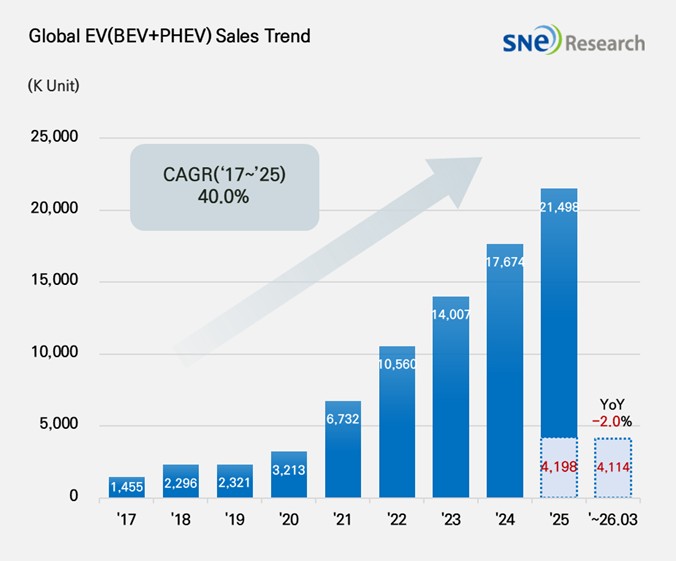
From Jan to Mar 2026, Global Electric Vehicle Deliveries Recorded 4.114 Mil Units, a 2.0% YoY Decline
- Europe maintains steady growth (26.7%), while both China and North America see a double-digit drop; -18.2% and -28.2%, respectively.
(Source: Global EV and Battery Monthly Tracker – Apr 2026, SNE Research)
Global electric vehicle (BEV+PHEV) deliveries from Jan to Mar 2026 totaled approximately 4.114 million units, representing a 2.0% decrease compared to the same period last year. Although the Chinese market still accounted for more than half of the total demand, its growth slowed down, causing global cumulative sales to shift toward a decline. In contrast, the European and Asian markets (excluding China) recorded double-digit growth, clearly illustrating a trend of regional demand restructuring.
(Source: Global EV and Battery Monthly Tracker – Apr 2026, SNE Research)
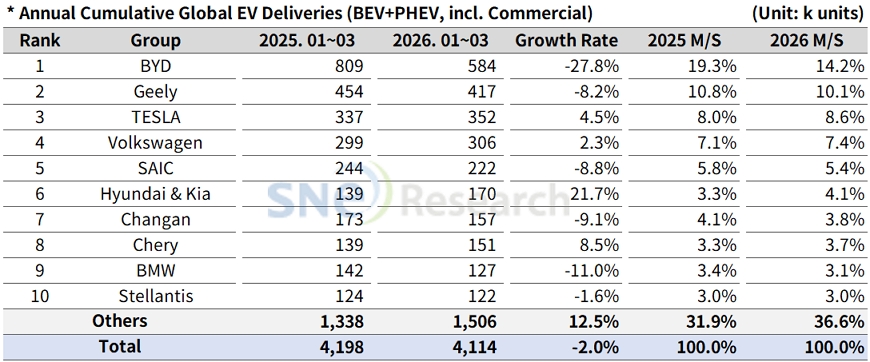
Looking at global electric vehicle (EV) deliveries by group from January to March 2026, BYD maintained its top position with 584,000 units, yet experienced a 27.8% decrease compared to the same period last year, causing its market share to drop from 19.3% to 14.2%. Geely also ranked second with 417,000 units but saw an 8.2% decline, while SAIC and Changan fell by 8.8% and 9.1% respectively, confirming a general slowdown among major Chinese manufacturers. This is interpreted as a direct reflection of sales in the Chinese market decreasing by 18.2% year-over-year.
In contrast, Tesla and Volkswagen recorded 352,000 and 306,000 units, representing increases of 4.5% and 2.3% respectively. Even as the overall global market experienced negative growth, Tesla showed a relatively resilient trend by raising its market share from 8.0% to 8.6%, and Volkswagen continued its steady growth backed by the recovery of the European market. Chery also showed relatively favorable performance among Chinese automakers, growing by 8.5% with 151,000 units delivered.
Hyundai Motor Group recorded 170,000 units from January to March 2026, marking a 21.7% increase compared to the same period last year—the highest growth rate among the top 10 groups. Its market share also rose from 3.3% to 4.1%. This highlights that the group continued to expand its sales in non-Chinese regions even as the overall global market contracted. Considering the particularly strong growth in Europe and Asia (excluding China), it is interpreted that the regional recovery in demand acted as a favorable factor for the group's performance improvement.
In contrast, BMW recorded 127,000 units, an 11.0% decrease, and Stellantis fell 1.6% to 122,000 units, showing a diverging trend even among major European groups. Sales for companies outside the top 10 reached 1,506,000 units, a 12.5% increase, with their market share expanding from 31.9% to 36.6%. This suggests that the concentration of power among a few leading players in the global EV market is easing somewhat, while mid-sized OEMs with regional strengths are seeing their influence grow.
(Source: Global EV and Battery Monthly Tracker – Apr 2026, SNE Research)
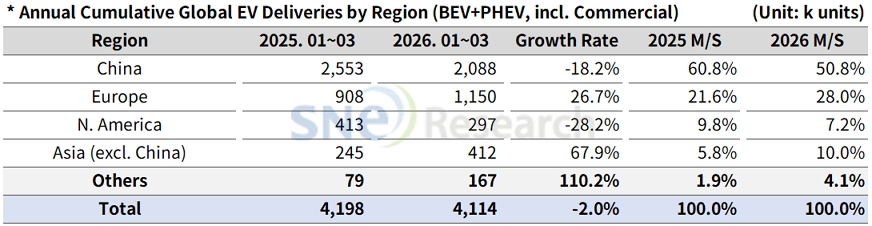
By region, China remained the largest market with 2.088 million units, but its market share fell from 60.8% to 50.8% as sales decreased by 18.2% year-over-year. In contrast, Europe grew by 26.7% with 1.15 million units, expanding its market share from 21.6% to 28.0%. North America recorded 297,000 units, a 28.2% decrease, marking the largest decline among major regions, while Asia (excluding China) showed the steepest growth trend, increasing by 67.9% to 412,000 units. Other regions also saw an expansion trend centered on emerging markets, rising 110.2% to 167,000 units.
This trend indicates that from January to March 2026, the global EV market entered a transition phase where growth axes are shifting based on regional demand variations and changes in the policy environment, rather than a phase of simple total demand expansion. As reliance on China decreases and the proportions of the European and Asian (excluding China) markets rise, the performance of automakers is clearly diverging based on their regional portfolios and local market responsiveness.
The current restructuring of the global EV market as of early 2026 is highly likely to continue for the time being. With double-digit declines persisting in the Chinese and North American markets, the market is assessed to have entered a structural transition period where policy changes, restructuring of consumer demand, and diversification of OEM strategies are occurring simultaneously, moving beyond a simple temporary adjustment. On the other hand, Europe has seen a rebound in EV sales coupled with the pressure of rising oil prices, and both the EU and China have hinted at the possibility of a compromise regarding the tariff conflict over Chinese-made EVs. This implies that the recovery in demand in the European market may lead to a reorganization of the competitive landscape rather than being a mere short-term bounce. Consequently, in the future global EV market, the sustainability of European demand, the expansion of the non-Chinese Asian market, and the ability to respond to changes in the trade environment will serve as key variables in market share fluctuations for each OEM, just as much as the recovery of domestic demand in China.