

Korean LIB Cells at $90/kWh: Lagging China in Cost, but Eyes Edge in Europe
- Total cost of BEV NCx for Korean battery makers is 80–90% higher than Chinese BEV LFP, posing a significant disadvantage in terms of margins
- China vs. Europe Production: Total production costs in Europe are 10–20% higher than in China
- Primary drivers of cost increases for European cell manufacturing include direct labor, utility costs, and yield-related losses
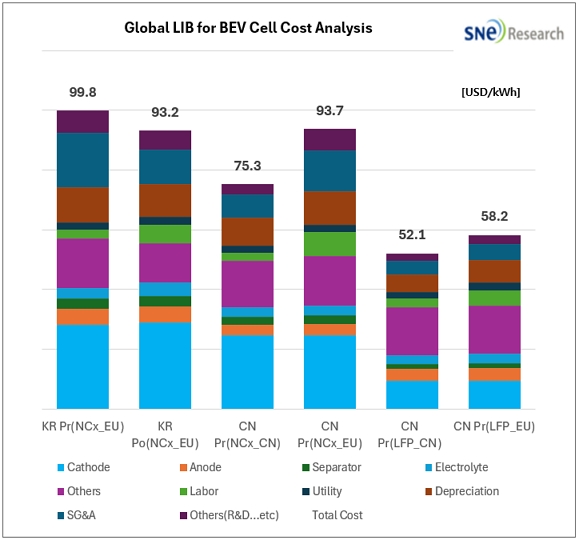
(Source: [2026.3] LIB Cell Cost/Price Analysis & Outlook by SNE Research)
According to the recently published report, [2026] Lithium-ion Battery Cell Cost/Price Analysis & Outlook by SNE Research, Chinese prismatic LFP cells for BEVs were analyzed to be the most cost-competitive, with a selling price of approximately $52.1/kWh as of 2025.
The analysis showed that South Korean ternary NCx prismatic cells and ternary NCx pouch cells were priced at $99.8/kWh and $93.2/kWh, respectively. These figures are 20–30% higher than Chinese NCx prismatic cells and 80–90% higher than Chinese LFP prismatic cells. The study found that South Korean companies are at a disadvantage compared to their Chinese rivals in terms of both battery raw material costs and processing expenses.
Specifically, Chinese firms were analyzed to hold a superior cost advantage over South Korean firms in categories such as cathodes (precursors), separators, electrolytes, packaging, processing costs, and Selling, General, and Administrative (SG&A) expenses.
Furthermore, a comparison by manufacturing site reveals that the total production cost for Chinese companies increases by 10–20% when shifting from China to Europe. Moving the manufacturing base for NCM and LFP cells to Europe leads to higher costs, primarily driven by surges in processing expenses, specifically direct labor and utility costs. Additionally, it is analyzed that operating production lines in Europe will incur higher costs due to yield-related losses, which are expected to be higher than those in China for the first two to three years of operation.
While the processing costs for Chinese companies producing in China are only about 55% of those of South Korean firms, they are projected to reach equivalent levels when production is based in Europe.
Ultimately, Chinese battery cell manufacturers are expected to face challenges when expanding into regions like Europe, due to increased initial investment costs and yield losses that drive up cell production expenses. This suggests that South Korea’s ‘Big Three,’ LG Energy Solution, Samsung SDI, and SK On, who have already established a presence in Poland and Hungary, likely hold an advantage in terms of the learning curve (load) and know-how gained through their previous yield stabilization efforts. Consequently, South Korean firms are anticipated to demonstrate stronger competitiveness in localized production.
The analysis and outlook of LIB costs and selling prices are the most critical factors determining the mass adoption of electric vehicles. To reduce battery prices, which account for 30% to 50% of total EV production costs, the industry is aggressively pursuing technological competition and supply chain vertical integration.
As of late 2024 to 2025, Chinese LFP cell prices have dropped to the $50–$60/kWh range, making them 80–90% more affordable than NCM batteries, which exceed $100/kWh. This widening price gap, fueled by China’s domestic production cost advantages, has prompted South Korean battery manufacturers to pivot and enter the production of high-cost-competitive LFP battery cells themselves.
As of 2025, China's CATL maintains an unrivaled top position in the global EV lithium-ion battery market with a share of approximately 39%, widening the gap with the second-tier group. Meanwhile, the combined market share of South Korea's ‘Big Three,’ LG Energy Solution, SK On, and Samsung SDI, has retreated to the 15% range and continued to struggle with further declines in early 2026. Consequently, these firms are now tasked with maintaining a ‘super-gap’ in battery technology while simultaneously achieving aggressive cost reductions.
A fierce competition among major players from South Korea, China, and Japan is expected as they vie for leadership in the LIB market. The market landscape is projected to shift significantly based on who can most effectively reduce cell costs and maximize profit margins. Therefore, establishing cost-reduction strategies through a granular ‘Cell Cost/Price Analysis & Outlook’ for each major manufacturer will be a critical factor for future success.