

From Jan to Feb 2026, Global EV Battery Cathode Installment Reached 297K ton, a 5.1% YoY Growth
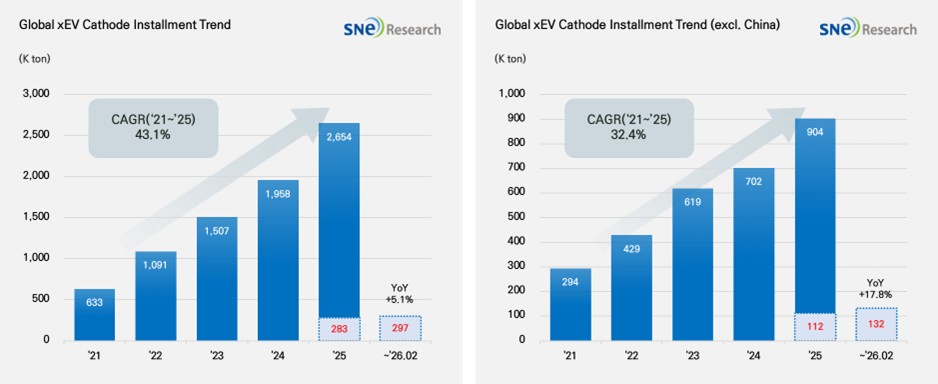
- EV battery cathode installment in the non-China market recorded 132K ton, a 17.8% YoY growth
(Source: 2026 Mar Global EV & Battery Monthly Tracker (Incl. LiB 4 Major Materials), SNE Research)
In January and February 2026, the total cathode material installation for electric vehicles (EV, PHEV, HEV) worldwide was tallied at 297K tons, marking a 5.1% increase year-over-year. Markets excluding China recorded 132K tons, growing by 17.8% and outpacing the global average. This indicates that the recovery in EV demand and the expansion of production in non-Chinese regions is directly driving the increased demand for cathode materials.
Regarding the demand structure, LFP (Lithium Iron Phosphate) chemistries continue to lead the growth, while ternary (NCx) materials showed a moderate upward trend, resulting in an ongoing adjustment of their relative market shares. The market’s central focus is also shifting, moving away from a competition centered solely on energy density toward a framework that prioritizes cost efficiency and supply stability.
(Source: 2026 Mar Global EV & Battery Monthly Tracker (Incl. LiB 4 Major Materials), SNE Research)
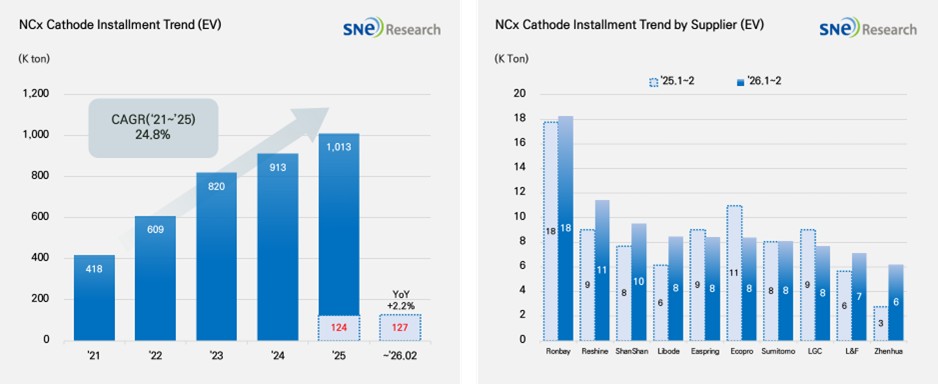
By type, the total installation of ternary cathode materials in January and February 2026 reached 127K tons, a 2.2% increase year-over-year. While the upward trend continued, the growth margin remained limited compared to LFP. Among suppliers, China’s Ronbay maintained its top position with approximately 18K tons, followed by Reshine (11K tons) and ShanShan (10K tons). South Korean firms, EcoPro, LG Chem, and L&F, along with Japan’s Sumitomo, secured spots in the Top 10, each recording around 7–8K tons.
As automakers intensify their strategies for cost reduction and the expansion of entry-level models, ternary materials are increasingly concentrating on demand for premium and high-energy-density segments. Chinese suppliers are successfully defending their market share based on economies of scale and price competitiveness. Meanwhile, South Korean and Japanese firms are strategically focusing on high-specification demand centered in North America and Europe. Consequently, while ternary materials are solidifying their position as ‘high-performance strategic materials,’ their short-term demand momentum remains highly sensitive to regional trade environments and shifts in OEM product mixes.
(Source: 2026 Mar Global EV & Battery Monthly Tracker (Incl. LiB 4 Major Materials), SNE Research)
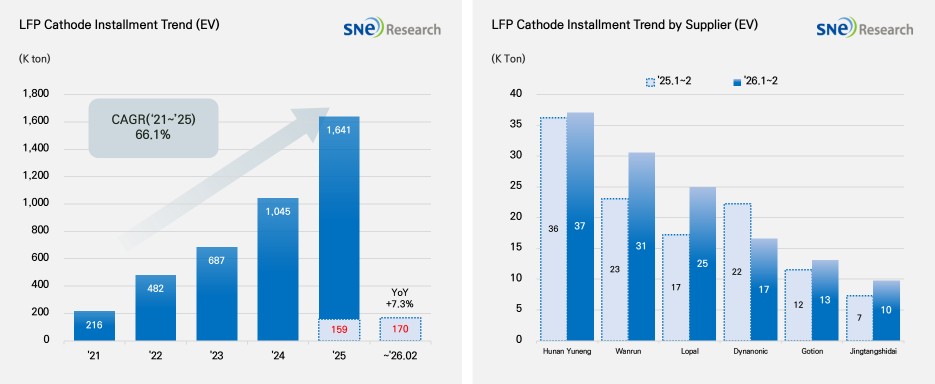
During the same period, the total installation of LFP-based cathode materials reached 170K tons, a 7.3% increase year-over-year. LFP’s share of total cathode material installations stood at approximately 57% (by weight), continuing to dominate the market by accounting for more than half of the total volume. As global automakers persist with strategies focused on cost reduction and the expansion of entry-level models, demand prioritizing price competitiveness and supply stability over energy density continues to expand.
By supplier, Hunan Yuneng ranked first with approximately 37K tons, followed by Wanrun (31K tons). The top ranks were predominantly occupied by Chinese firms, including Lopal (25K tons), Dynanonic (17K tons), Gotion (13K tons), and Jingangshida (10K tons).
While the launch of budget-friendly EVs is increasing in Europe and parts of Asia, the LFP supply chain remains overwhelmingly centered on China. Although attempts to invest in local production and achieve technological insourcing are ongoing in non-Chinese regions, the supply landscape is unlikely to undergo a rapid reshuffling in the short term, given the competitive advantages of the integrated process—from raw material procurement to the production of precursors and LFP cathode materials.
The cathode material market in early 2026 maintained its growth trajectory, yet it clearly reflected the impact of slowing EV sales due to policy uncertainties and seasonal off-peak effects. While global EV sales declined by 7.0% year-over-year, the growth rate of cathode material installations also showed a moderate trend compared to the previous high-growth phases.
However, it is a positive sign that the EV market excluding China grew by 18.4%, demonstrating a relatively strong recovery. The expansion of production and model diversification in non-Chinese regions are effectively buffering the demand for cathode materials. Nevertheless, the overall market direction remains heavily influenced by the volatility of the Chinese market, and global growth momentum has noticeably weakened.
In summary, the cathode material market in early 2026 is increasingly characterized by ‘structural realignment amidst a slowdown’ rather than ‘sustained growth.’ The future direction of the market is expected to be determined by the pace of global EV demand recovery, intensifying competition within China, and the speed of production expansion and localized supply chain establishment in non-Chinese regions. While signals of recovery are emerging in Europe, the U.S. market remains weak; therefore, the key variable moving forward is likely to be the disparity in regional demand recovery rather than a synchronized global rebound.