

From Jan to Feb 2026, Non-China Global Electric Vehicle Deliveries Recorded 1.132 Mil Units, a 18.4% YoY Growth
- Europe and Asia (excl. China) remained in an upward trend, while North America experienced a double-digit decline
(Source: Global EV & Battery Monthly Tracker – Mar 2026, SNE Research)
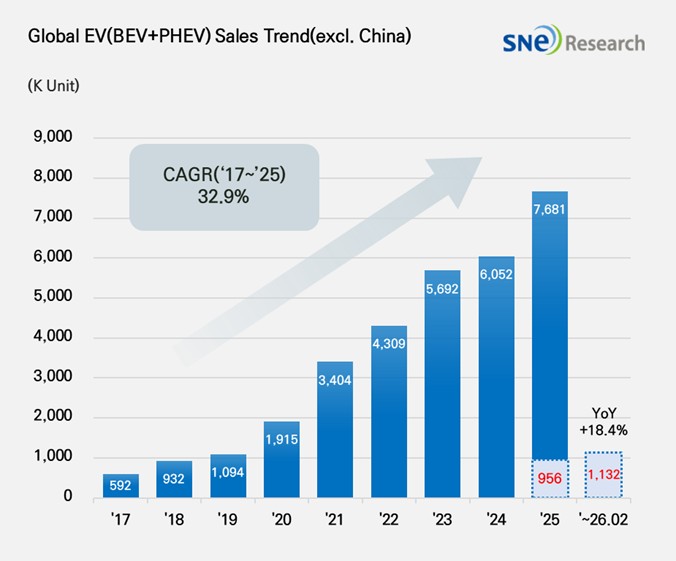
From Jan to Feb 2026, global electric vehicle (BEV+PHEV) deliveries excluding China totaled approximately 1.132 million units, representing a 18.4% year-on-year (YoY) increase. Despite a downturn in the North American market, the non-China global market maintained a relatively steady trend, supported by continued growth in Europe and Asia (excl. China). Notably, a distinct regional divergence emerged, with the stable expansion in Europe and high-speed growth in emerging Asian markets serving as the primary drivers of overall performance.
On a cumulative basis, the global EV market (excluding China) has maintained a Compound Annual Growth Rate (CAGR) of 32.9% since 2017. Although some regions are currently experiencing policy adjustments and demand restructuring, the overall analysis suggests that the market is staying its mid-to-long-term expansion path, supported by the sustained momentum of the structural transition to electrification.
(Source: Global EV & Battery Monthly Tracker – Mar 2026, SNE Research)
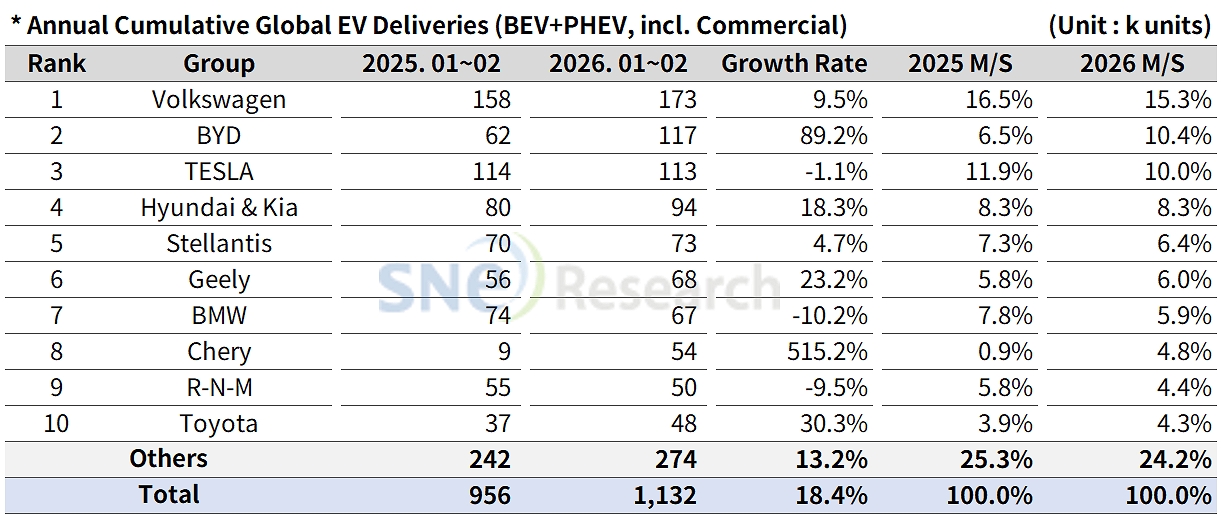
By group, Volkswagen Group ranked first in global EV deliveries (excluding China), selling 173,000 units, a 9.5% increase year-over-year. Sales expansion was driven by MEB platform-based models such as the ENYAQ and ELROQ, particularly in the European market. This trend is interpreted as a result of maintaining stable demand within Europe through its diverse brand portfolio, including Volkswagen, Audi, Škoda, and Porsche. Its strategy of linking a wide-ranging portfolio, spanning from mass-market to premium brands, to a common electrification platform serves as the foundation of its competitiveness in non-Chinese markets.
BYD took the second spot, demonstrating rapid expansion in non-Chinese markets with high growth rates of 80.5% in Asia (excluding China) and 104.1% in Europe. The analysis suggests that the expansion of local distribution networks and the introduction of strategic models focused on price competitiveness have driven this sales growth. Notably, its brand awareness is improving rapidly in Southeast Asia and key European countries, signaling that its sales foundation is taking full shape. The strategy to reduce reliance on the Chinese domestic market and increase its overseas share is leading to tangible results, and its moves to expand local assembly and production hubs are evaluated as factors strengthening its mid-to-long-term growth foundation. This sharp increase in volume in non-Chinese markets is seen as a significant shift in terms of diversifying its global sales structure.
Tesla fell to third place as its sales decreased by 1.1% year-over-year to 113,000 units. Despite significant growth in Asia and other regions, the decline was driven by a 13.1% and 6.6% drop in its major markets, North America and Europe, respectively. This downturn appears to be the result of an aging model lineup, intensifying competition in key regions, and policy uncertainties. As Tesla recently phased out the Model S and X to pivot toward a software-centric strategy and advanced Full Self-Driving (FSD) technology, it is highly likely to respond to regional demand disparities and short-term sales volatility in the near term by maintaining an efficient product portfolio centered on the new Model Y and focusing its operations on flagship models.
(Source: Global EV & Battery Monthly Tracker – Mar 2026, SNE Research)
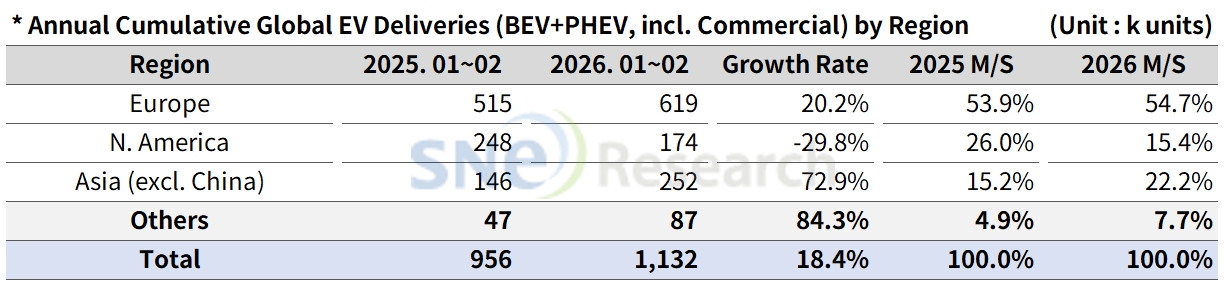
In the first two months of 2026, the global EV market (excluding China) saw diverging regional trends become more pronounced, as steady growth in Europe contrasted with a rapid adjustment in North America. As the incentive structures and regulatory frameworks of major nations and regions shift in 2026, policy adaptability and the pace of supply chain restructuring—rather than short-term sales performance—are emerging as the core variables determining the market's future direction.
The North American market is undergoing an even faster adjustment phase than China. Following the premature termination of federal EV tax credits under the U.S. Inflation Reduction Act (IRA), the increased price burden on consumers has directly translated into a demand slowdown in early 2026. Furthermore, as major automakers shift their strategic focus from the sole expansion of Battery Electric Vehicles (BEVs) to include Hybrids and Extended-Range Electric Vehicles (EREVs), the growth momentum of the North American EV market has visibly weakened. Short-term, this is viewed as a period where a policy vacuum and demand adjustment coexist.
Conversely, the European market continues to maintain a relatively stable expansionary trend among major regions. Despite ongoing discussions regarding subsidy cuts or regulatory adjustments, the fundamental direction of the electrification transition remains steadfast, underpinned by corporate average emission standards and a consistent carbon regulation framework. Notably, the full-scale supply of new BEV models launched since the second half of 2025 is gradually broadening the sales base, while the increasing share of price-competitive small and mid-sized models is positively contributing to sustained demand. Coupled with the expansion of regional production and supply chain restructuring, Europe is solidifying its position as a market where structural demand outweighs the impact of short-term incentive changes.
Asia (excluding China) and other emerging regions are also maintaining a relatively robust trajectory. However, the key takeaway is that policy axes in these markets are shifting away from simple subsidy expansions toward support mechanisms linked to local production and parts procurement. Centered on Thailand and Indonesia, factors such as localized manufacturing, parts localization, and the establishment of export hubs are emerging as critical benchmarks for market expansion. In some emerging economies, there is a growing trend to pair EV import expansion with the nurturing of domestic industries. As South America and other emerging regions also shift their policies toward a combination of tariffs, local assembly, and production incentives, localized supply chain capabilities, rather than mere sales volume, are likely to become a more decisive competitive factor moving forward.
In early 2026, the global EV market (excluding China) is becoming increasingly differentiated based on regional policy environments and industrial foundations. While Europe continues its relatively stable expansion underpinned by regulatory-driven demand and the impact of new model launches, North America is seeing its growth momentum weaken as demand adjustment progresses rapidly following the expiration of incentives. Meanwhile, Asia (excluding China) and other emerging regions are emerging as new growth axes, with market structures being reshaped around localized production, parts procurement, and supply chain integration rather than subsidy expansion. Consequently, the competitive landscape in non-Chinese markets is increasingly likely to be determined by responsiveness to regional regulatory changes and localization execution capabilities, rather than simple sales expansion.