

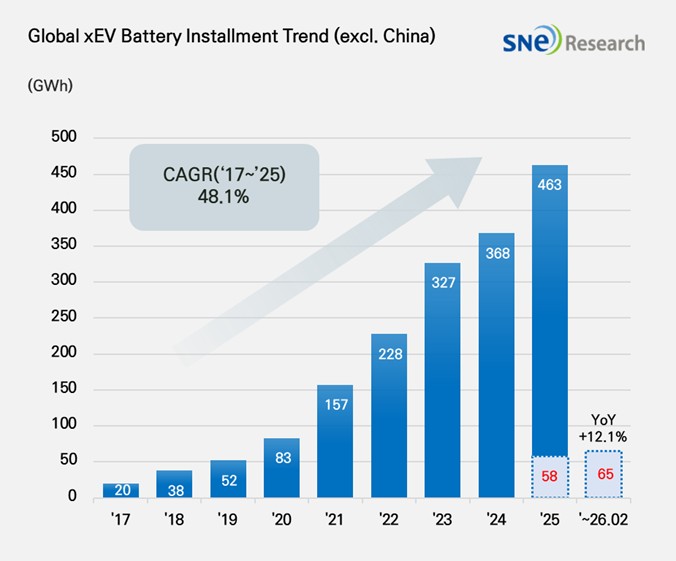
From Jan to Feb 2026, Non-Chinese Global[1] EV Battery Usage[2] Posted 65GWh, a 12.1% YoY Growth
- From Jan to Feb 2026, K-trio’s combined M/S recorded 28.4%, a 8.8%p YoY decline
Battery installation for global
electric vehicles (EV, PHEV, HEV) excluding the Chinese market sold from Jan to
Feb 2026 was approximately 65.3GWh, posting a 12.1% YoY growth.
(Source: Global EV and Battery Monthly Tracker – Mar 2026, SNE Research)
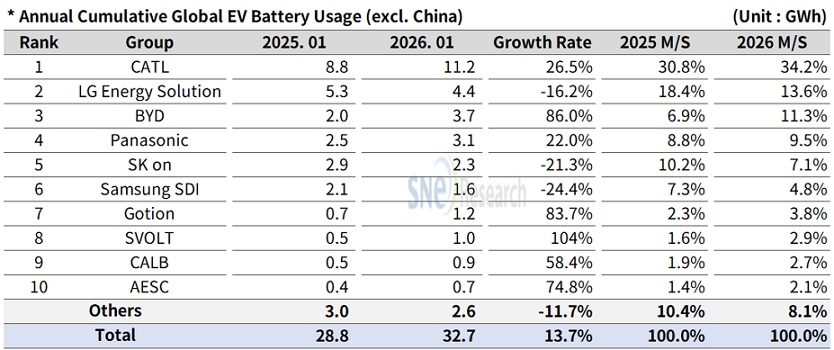
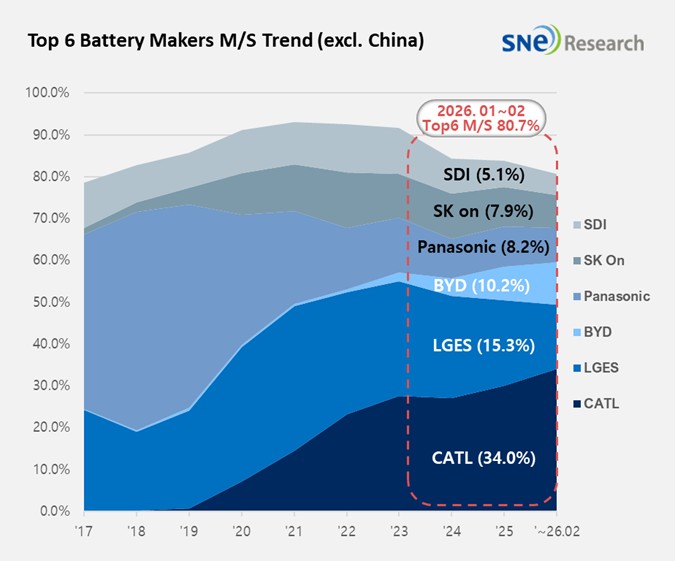
In January and February 2026, the combined global market share (excluding China) of the three major Korean battery manufacturers—LG Energy Solution, SK On, and Samsung SDI—recorded 28.4%, an 8.8 percentage point (p) drop compared to the same period last year. All three companies experienced negative growth: LG Energy Solution declined by 12.4% (10.0 GWh), SK On by 12.9% (5.2 GWh), and Samsung SDI by 21.9% (3.3 GWh). This downturn is attributed to a 29.8% slump in EV sales within the U.S. market, alongside a broader slowdown in EV sales among major automakers, which directly led to reduced battery usage. In contrast, Chinese battery manufacturers such as CATL and BYD continued to expand their presence in the global market (excluding China), resulting in a further contraction of the relative market standing for Korean firms.
(Source: Global EV and Battery Monthly Tracker – Mar 2026, SNE Research)
An analysis of the battery usage of the three major Korean manufacturers by customer shows that Samsung SDI maintained a high supply concentration for BMW, Audi, and Rivian. However, as EV sales slowed across its major customer base, Samsung SDI’s battery installation volume declined. In particular, for customers with a high dependency on the North American market, such as Rivian and Jeep, the direct impact of the slump in U.S. EV sales led to a wider decrease in battery usage.
BMW saw a reduction in installation volume as sales declined across its key electrified models, including the i4, i5, i7, and iX. For Audi, despite the launch of the Q6 e-Tron, sales performance fell short of expectations. Furthermore, the introduction of the Q6 e-Tron created a cannibalization effect that reduced sales of the existing Q8 e-Tron, ultimately contributing to the overall decline in total battery installation volume.
SK On’s batteries were primarily installed in major vehicles from Hyundai Motor Group, Mercedes-Benz, Ford, and Volkswagen. For Hyundai Motor Group, battery installation volume increased due to stable sales of the IONIQ 5 and the launch effect of the new IONIQ 9. However, slowing EV sales across other key customers, including Kia, Mercedes-Benz, and Volkswagen, led to an overall decline in total installations. In particular, Ford saw a sharp drop in sales due to the production halt of the F-150 Lightning, which acted as a major factor in the reduction of SK On’s battery usage. This decline was further exacerbated by the broader slowdown in EV demand within the U.S. market. Volkswagen also saw a significant reduction in installations, driven by a noticeable slump in ID.4 sales. While growth was observed in certain models and new releases, it was limited and insufficient to reverse the overall downward trend.
LG Energy Solution’s battery usage was largely driven by installations in major vehicles from Tesla, Chevrolet, Kia, and Volkswagen. For Tesla, battery installation volume surged on the back of strong Model Y sales, while Kia also saw increased usage following the launch of new models like the EV4 and expanded sales of existing vehicles. Renault and Škoda also showed growth, reflecting increased sales of their key EV models. However, slowing EV sales among other major customers, such as Chevrolet, Ford, and Volkswagen, weighed on the total battery usage. Chevrolet and Ford experienced a marked decline in sales of their primary EV models, and Volkswagen’s installation volume dropped significantly due to continued sluggish sales of the ID.4. Consequently, LG Energy Solution’s total battery usage recorded a slight year-over-year decrease.
Panasonic, which maintains a high supply concentration for Tesla, recorded 5.3 GWh in battery usage during January and February 2026, marking a 2.7% increase year-over-year. While sales of the Model Y, a key customer model, showed prominent growth, demand for the Model 3, Model S, and Model X declined, signaling a shift in the demand structure across different vehicle types. In particular, with the discontinuation of the Model S and Model X now confirmed, a decrease in battery demand due to the scaling back of the high-end lineup appears inevitable. Amidst these trends, Panasonic is focusing on developing next-generation 4680 and 2170 cells and improving North American production efficiency to reduce its heavy reliance on Tesla. These strategic moves are expected to buffer the risks associated with Tesla's expanding in-house production and contribute to maintaining Panasonic’s mid-to-long-term market share in North America.
China’s CATL maintained its global number one position (excluding China), recording 22.2 GWh in January and February 2026, a 27.4% increase compared to the same period last year. This growth was primarily driven by a significant surge in battery installations for major global automakers, including Toyota, Kia, Skoda, and Tesla. Additionally, the overseas expansion of certain Chinese OEMs, such as JAECOO, Changan, and ZEEKR, contributed to CATL's growth. Conversely, battery usage for some customers, such as Volkswagen and BMW, declined due to slowing sales, resulting in divergent trends among clients. These movements demonstrate that CATL is further solidifying its market dominance by expanding its supply chain based on partnerships with global OEMs, even in non-Chinese markets.
BYD maintained its third-place position in the global market (excluding China), recording 6.7 GWh in battery usage during January and February 2026, a 68.2% increase year-over-year. Notably, in contrast to the slowing trend in the Chinese domestic market, its battery usage in non-Chinese markets grew significantly, driven by a substantial expansion in EV sales. The primary growth driver was the increasing global sales of its own brand (BYD), further supported by rising supplies to international automakers such as Mahindra & Mahindra and KG Mobility. Additionally, its customer base continued to broaden as supplies to new clients, including Suzuki, Toyota, and Jeep, began in earnest. These trends demonstrate that BYD is successfully expanding its global footprint, transitioning away from a structure centered solely on the Chinese domestic market.
(Source: Global EV and Battery Monthly Tracker – Mar 2026, SNE Research)
In January and February 2026, the global secondary battery market for electric vehicles (excluding China) continued its robust expansion, recording double-digit growth year-over-year. However, the competitive landscape within the market intensified significantly. Despite the slowdown in demand in North America, growth was driven by Europe and Asia (excluding China), clearly signaling a diversification of regional growth axes.
In this environment, Chinese battery manufacturers such as CATL and BYD are rapidly expanding their market share in non-Chinese markets, leveraged by expanded cooperation with global OEMs and aggressive overseas entry. In contrast, the three major Korean battery manufacturers saw their growth momentum weaken and market share decline, as their customer base, which is heavily reliant on the North American market, coincided with the slowing sales of major OEMs.
Consequently, in the non-Chinese market, responsiveness to regional demand shifts and the ability to expand partnerships with global OEMs are emerging as more critical competitive factors than simple growth in EV demand. Moving forward, diversifying customer portfolios and securing product competitiveness in response to the rising demand centered on Europe and emerging markets will likely serve as the pivotal variables determining the market standing of battery manufacturers.
[2] Based on battery installation for xEV registered during the relevant period.