

In Jan 2026, Non-China Global Electric Vehicle Deliveries Recorded 572k units, a 21.2% YoY Growth
- Europe and Asia (excl. China) remained in an upward trend, while North America experienced a double-digit decline
(Source: Global EV & Battery Monthly Tracker – Feb 2026, SNE Research)
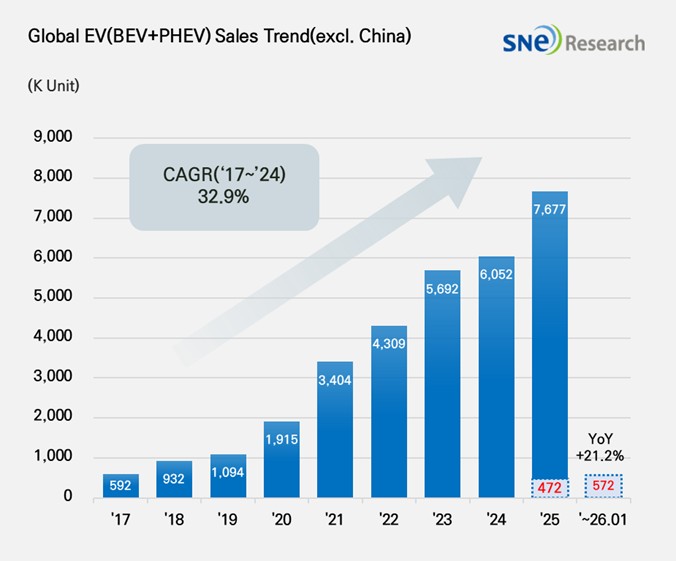
In January 2026, global electric vehicle (BEV+PHEV) deliveries excluding China totaled approximately 572,000 units, representing a 21.2% year-on-year (YoY) increase. Despite a downturn in the North American market, the non-China global market maintained a relatively steady trend, supported by continued growth in Europe and Asia (excl. China). Notably, a distinct regional divergence emerged, with the stable expansion in Europe and high-speed growth in emerging Asian markets serving as the primary drivers of overall performance.
On a cumulative basis, the global EV market excluding China has maintained a Compound Annual Growth Rate (CAGR) of 32.9% since 2017. Although some regions are currently experiencing policy adjustments and demand restructuring, the market is analyzed to be maintaining its long-term expansion trajectory, underpinned by the ongoing structural transition to electrification.
(Source: Global EV & Battery Monthly Tracker – Feb 2026, SNE Research)
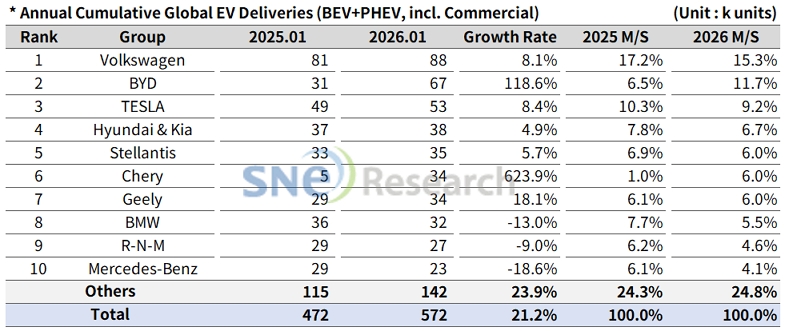
By group, Volkswagen Group maintained its top-tier position in the global EV market (excluding China), delivering 88,000 units in January 2026, an 8.1% year-on-year (YoY) increase. Sales of MEB platform-based models, such as the ID.4, ID.7, and ENYAQ, remained stable primarily in the European market. Performance was further bolstered by the gradual ramp-up of new models utilizing the high-performance PPE (Premium Platform Electric) platform.
The group’s core competitiveness in the non-China market stems from its ability to bridge a wide-ranging portfolio—from mass-market to premium brands—through a unified electrification platform strategy. While growth has moderated compared to previous double-digit expansion phases, this reflects a strategic shift toward a balanced operational approach that prioritizes both profitability and volume.
Ranked second, BYD demonstrated a formidable expansion in non-China markets, recording a 118.6% year-on-year (YoY) increase in January 2026. The group achieved explosive triple-digit growth rates of 124.8% in Asia (excl. China) and 126.6% in Europe, signaling a rapid penetration into global territories. This surge was primarily driven by the aggressive build-out of local distribution networks and the strategic deployment of models optimized for price competitiveness. Notably, BYD’s brand awareness is improving swiftly across Southeast Asia and major European nations, establishing a solid foundation for sustained sales.
Ranked third, Tesla exhibited a solid recovery in the non-China market, selling 53,000 units in January 2026—an 8.4% year-on-year (YoY) increase. While sales of the flagship Model 3 and Model Y remained stable across North America and Europe, the recently introduced entry-level Standard trims played a pivotal role in broadening the customer base.
Notably, Tesla successfully defended demand by pairing strategic price adjustments with aggressive financial promotions, effectively mitigating the impact of the federal incentive expiration. However, the volume contribution from the premium segment and newer models remains limited, indicating that growth continues to be heavily concentrated around its primary high-volume models.
(Source: Global EV & Battery Monthly Tracker – Feb 2026, SNE Research)
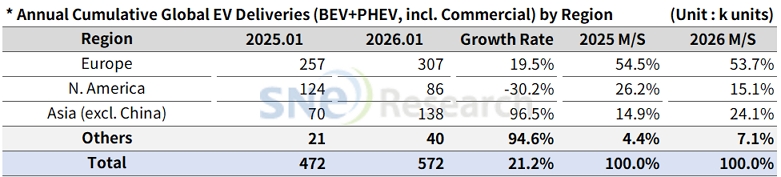
In January 2026, the global EV market excluding China exhibited a distinct regional divergence, characterized by Europe’s continued growth and North America’s slowdown. Entering 2026, as incentive structures and regulatory frameworks shift across major regions, the market is moving into a phase where policy adaptability and the pace of supply chain realignment—rather than short-term sales fluctuations—will dictate the industry's direction.
The European EV market maintained its double-digit growth rate in January 2026, demonstrating the most stable trend among major global regions. Despite ongoing debates regarding subsidy reductions and policy adjustments, the transition to electrification remains structurally sound, underpinned by strict carbon emission regulations and fleet-wide average emission targets.
Specifically, the market foundation is expanding as the supply of new BEV models launched in the second half of 2025 reaches full scale. The increasing share of compact and mid-sized BEVs with improved price competitiveness is enhancing consumer accessibility. Furthermore, amidst shifting trade regulations against low-cost Chinese imports, the localization of production within Europe is strengthening supply stability. Consequently, Europe is evaluated as being in a stage where the structural electrification trend persists, independent of short-term incentive volatility.
The North American EV market entered a distinct adjustment phase in January 2026, recording its steepest decline to date. Since the expiration of federal EV tax credits in late September 2025, rising price burdens have led to a rapid deceleration in consumer demand.
Simultaneously, as North American consumer preferences shift back toward Internal Combustion Engines (ICE) and Hybrids, major OEMs are recalibrating their EV rollout timelines. The strategic pivot from a BEV-only expansion to a more diversified approach, centered on Hybrids and EREVs, is also acting as a primary factor limiting immediate BEV demand.
The Asian market (excluding China) continues its growth trajectory in early 2026. However, the most significant shift is the policy pivot from simple ‘subsidy expansion’ toward ‘incentives linked to local production and supply chains.’ Thailand is refining its EV3/EV3.5 programs to manage fiscal burdens while reinforcing its status as a production and export hub—granting operational flexibility while tightening conditional management to induce stable market expansion. Indonesia has effectively phased out CBU (Completely Built-Up) incentives as of 2026, demanding local production and compliance with TKDN in proportion to import volumes. Consequently, the market is restructuring around OEMs that meet these localization mandates. In this region, long-term growth will be dictated by an OEM’s execution in adapting to these evolving local production requirements rather than short-term sales volatility.
In January 2026, the global EV market excluding China grew by 21.2% year-on-year, signaling a steady expansion of EV adoption and a strengthening demand base in non-Chinese markets. Europe maintains stable volume growth driven by regulatory frameworks and new model launches, while the Rest of Asia is in a structural refinement phase based on localization mandates and industrial promotion policies. Conversely, North America is experiencing a slowdown due to shifting policy landscapes and a rebalancing of powertrain preferences. Ultimately, the non-China market is forming distinct growth paths by region. For global OEMs, product configuration tailored to regional characteristics, pricing strategies, and the operational efficiency of production hubs have emerged as the core variables determining success.