

In Jan 2026, Non-Chinese Global[1] EV Battery Usage[2] Posted 32.7GWh, a 13.7% YoY Growth
- In Jan 2026, K-trio’s combined M/S recorded 25.5% (except China market)
Battery installation for global
electric vehicles (EV, PHEV, HEV) excluding the Chinese market sold in Jan 2026
was approximately 32.7GWh, posting a 13.7% YoY growth.
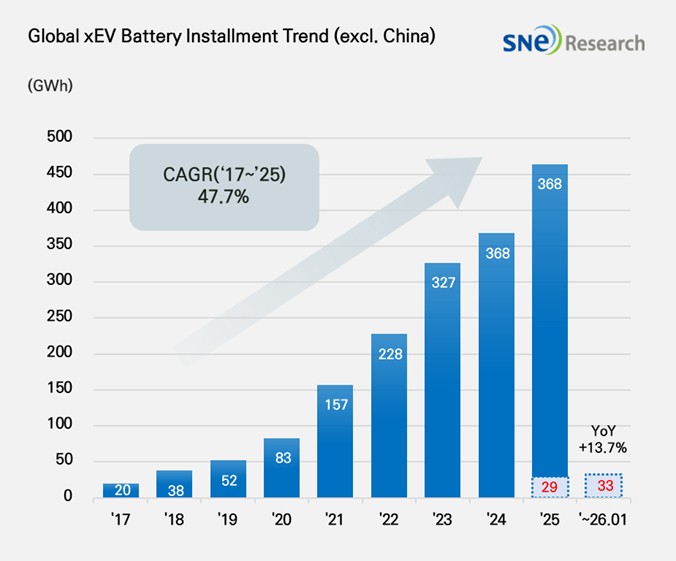
(Source: Global EV and Battery Monthly Tracker – Feb 2026, SNE Research)
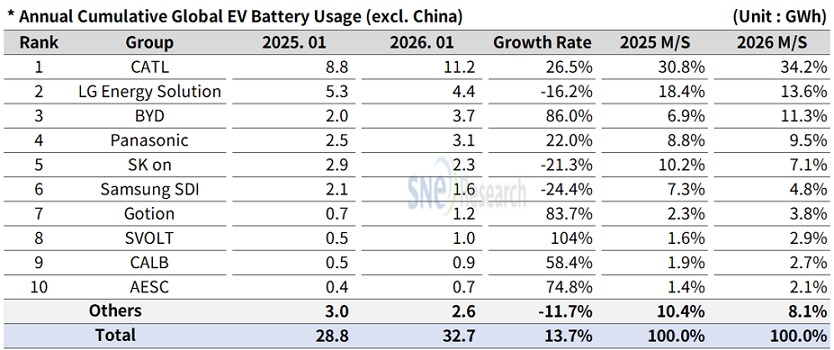
In January 2026, the combined global market share of the three major Korean battery manufacturers—LG Energy Solution, SK on, and Samsung SDI—fell by 10.4 percentage points year-on-year (YoY) to 25.5%.
All three companies recorded negative growth in battery usage: LG Energy Solution declined by 16.2% (4.4 GWh), SK on by 21.3% (2.3 GWh), and Samsung SDI by 24.4% (1.6 GWh). This downturn is primarily attributed to the sharp contraction in electric vehicle sales within the U.S. market, which serves as a key stronghold for Korean battery makers.
(Source: Global EV and Battery Monthly Tracker – Feb 2026, SNE Research)
Looking at battery usage alongside OEM sales trends, Samsung SDI’s supply was highly concentrated in BMW, Audi, Rivian, and Land Rover, in that order. While Samsung SDI continues to supply batteries for BMW’s core electrified lineup (i4, i5, i7, and iX), installation volumes shrank due to the sales slowdown in the U.S. Audi saw a relatively positive reception in Europe for the PPE platform-based Q6 e-tron equipped with Samsung SDI batteries; however, the ongoing sluggish sales of the Q8 e-tron led to an overall decrease in usage. For Rivian, although its R1S and R1T models utilize Samsung SDI cells, growth was limited by the expanding share of standard trims and general weakness across the U.S. market.
SK On’s battery installations were primarily driven by Hyundai Motor Group (HMG), Ford, Mercedes-Benz, and Volkswagen. Within HMG, IONIQ 5 and EV9 were major contributors, while sales of Ford’s Puma and Explorer also supported SK On’s volumes. However, a sharp drop in sales for the Ford F-150 Lightning—following the late 2025 production halt announcement—combined with the dissolution of BlueOval SK (the SK On-Ford JV), is expected to weigh heavily on SK On’s demand. Furthermore, since the early expiration of IRA tax credits in September 2025, sales from U.S. domestic OEMs have slowed, and a significant dip in sales from European and Korean OEMs in the U.S. made negative growth unavoidable for SK On.
LG Energy Solution batteries were mainly integrated into vehicles from Tesla, HMG, Renault, and Volkswagen. While Tesla models equipped with LGES cells suffered from sluggish global sales, HMG’s core models like the Kia EV series and Hyundai Casper (Inster) EV maintained resilient performance. Nevertheless, LGES also faced a downward trend as sales from local U.S. OEMs, including Cadillac, Chevrolet, GM, and Ford, plummeted following the early termination of the IRA subsidies.
In January 2026, Panasonic recorded 3.1 GWh in battery usage, securing the 4th position globally. Unlike the South Korean ‘K-Trio,’ Panasonic maintained an upward trend, largely because the sales decline of its primary customer, Tesla, was relatively limited compared to other U.S.-based OEMs. To mitigate its heavy reliance on Tesla, Panasonic is focusing on enhancing the efficiency of its North American production lines and accelerating the development of 4680 and 2170 cells. With the retooling of its Kansas and Nevada plants gaining momentum, Panasonic is stabilizing its cost structure while expanding discussions for new partnerships with North American automakers. This strategy is expected to buffer the risks associated with Tesla's vertical integration and defend its mid-to-long-term market share in North America.
China’s CATL maintained its top position outside the Chinese domestic market, reaching 11.2 GWh, a 26.5% year-on-year (YoY) increase. Beyond supplying Chinese OEMs expanding internationally, CATL broadened its installation base by partnering with diverse global players such as Volkswagen and Audi. Significant growth was observed across Europe and emerging markets (excluding the U.S.), further bolstered by an increase in the average battery capacity of Chinese EVs. While maintaining its lithium-ion-centric portfolio, CATL is also reinforcing its future-readiness by pushing for the commercialization of sodium-ion batteries.
BYD secured the 3rd spot with an 86.0% surge to 3.7 GWh. This result reflects a strategic shift prioritizing international investment and sales over domestic Chinese expansion. While its usage in China fell by 23.4%, it skyrocketed in Europe (+69.4%) and other regions (+97.6%), showing a distinct regional divergence. Leveraging its vertical integration (in-house production of both batteries and EVs), BYD is expanding its presence globally through superior price competitiveness across various vehicle segments. Additionally, to further enhance cost leadership, BYD is reportedly investing in sodium-ion battery production with an aim to establish a 30 GWh annual capacity.
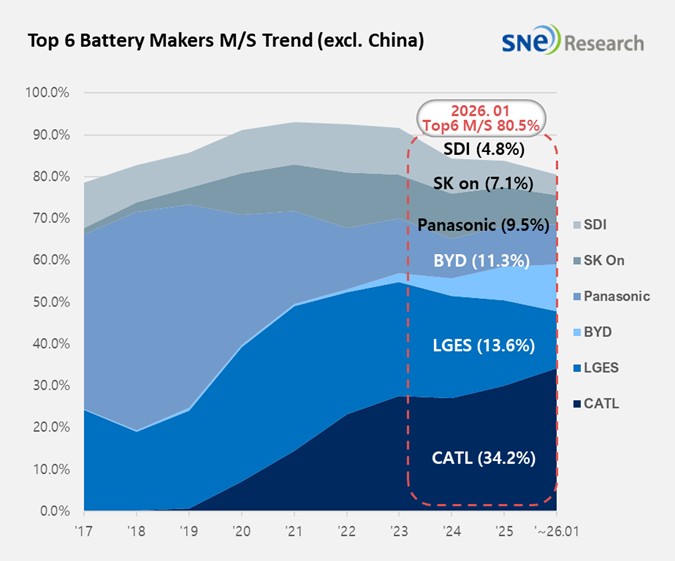
(Source: Global EV and Battery Monthly Tracker – Feb 2026, SNE Research)
In 2025, the global EV battery market outside of China sustained its quantitative growth, expanding by 26.0% year-on-year. However, a significant realignment of the competitive landscape led to a decline in the combined market share of the three major Korean battery makers. This trend persisted into January 2026, with Chinese manufacturers expected to continue their market share gains for the foreseeable future. Despite the geographical distinction of the ‘Non-China’ market, the rapid expansion of CATL and BYD remains a dominant force. This shift is primarily driven by global OEMs diversifying their supply chains and the intensifying price competition across the industry.
Consequently, Korean manufacturers are facing increased earnings volatility tied directly to the sales performance of their key customers. In 2026, demand uncertainty in North America and the rising influence of Chinese players in Europe are expected to weigh heavily on shipment volumes and profitability recovery. However, the degree to which these companies can defend their competitiveness will likely depend on their ability to capitalize on expanding ESS demand and successful product portfolio adjustments. Ultimately, the trajectory of their future performance will be dictated by changes in their customer mix and the agility of their business strategies.
[2] Based on battery installation for xEV registered during the relevant period.