

Global FCEV Market Projected to Reach 3.03 million Units by 2040, with Commercial Vehicles Accounting for 70%
Expansion of Hydrogen Mobility Focused on Commercial Vehicles: Market Share in Europe and North America Growing Rapidly
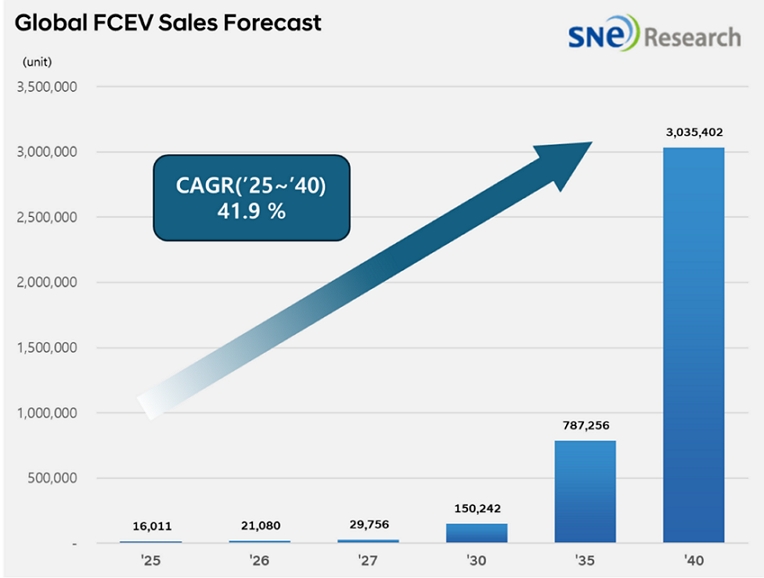
According to market analysis by SNE Research, the global Fuel Cell Electric Vehicle (FCEV) market is expected to witness rapid growth, expanding from approximately 16,000 units in 2025 to 3.03 million units by 2040. This represents a Compound Annual Growth Rate (CAGR) of 41.9% over the forecast period.
As global carbon neutrality policies tighten and the demand for decarbonization in the commercial transport sector rises, FCEVs are emerging as a pivotal solution for mid-to-long-term mobility transition. Particularly in long-haul and heavy-duty commercial segments, hydrogen fuel cell technology is highly regarded for its ability to overcome the limitations of Battery Electric Vehicles (BEVs). Consequently, major nations are accelerating the development of hydrogen-based transportation infrastructure.
SNE Research forecasts that global FCEV sales will grow from 16,000 units in 2025 to 150,000 units by 2030, and reach 780,000 units by 2035, eventually hitting the 3.03 million mark by 2040. This trajectory reflects a strategic shift into a full-scale growth phase, initially led by the adoption of hydrogen technology in the commercial vehicle sector.
(Source: 2026 Feb Global FCEV Monthly Tracker, SNE Research)
Structural Expansion Toward a Commercial Vehicle-Centric Market
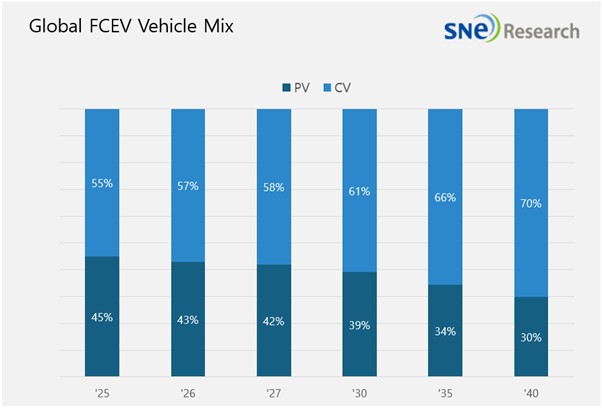
By vehicle type, the FCEV market is expected to shift rapidly from passenger-oriented to a commercial vehicle-centric structure. While commercial vehicles (CVs) are estimated to account for approximately 55% of global FCEV sales in 2025, this share is projected to rise to 61% by 2030, 66% by 2035, and reach 70% by 2040, driven by the high utility of hydrogen fuel cell technology in long-haul and heavy-duty transport.
In particular, hydrogen trucks and buses are poised to become the primary growth engines of the FCEV market, as they offer distinct competitive advantages—such as longer driving ranges and shorter refueling times—required for demanding logistical environments. This trend underscores the pivotal role of hydrogen-based mobility in the global logistics and transportation industry’s transition toward decarbonization.
(Source: 2026 Feb Global FCEV Monthly Tracker, SNE Research)
Market Expansion: From Asia-Centric to Global Diversification
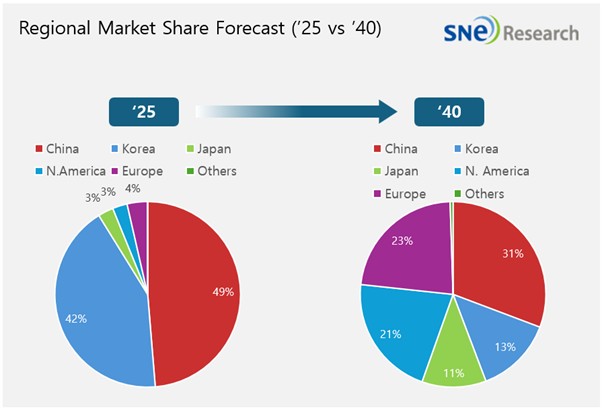
The regional structure of the global FCEV market is also expected to undergo significant transformation over time. Currently, the market is heavily concentrated in China and South Korea, which together account for approximately 90% of global FCEV sales as of 2025. This concentration is a direct result of intensive policy support and early-stage infrastructure development in these two nations.
However, from 2030 onwards, the market is projected to diversify as Europe and North America enter a phase of rapid growth. According to SNE Research, the regional market shares by 2040 are expected to be China (31%), Europe (23%), North America (21%), South Korea (13%), and Japan (11%). Notably, Europe and North America are poised to emerge as major growth hubs, driven by aggressive decarbonization policies in the commercial transport sector and expanding investments in hydrogen infrastructure.
(Source: 2026 Feb Global FCEV Monthly Tracker, SNE Research)
Policy and Infrastructure: The Pivotal Variables for Growth
As the FCEV market is still in its early adoption stage, its expansion pace is highly sensitive to the regulatory environment and the speed of infrastructure deployment. Several factors, including hydrogen production costs, the establishment of refueling networks, and vehicle price competitiveness—are expected to influence the rate of commercialization. In particular, decarbonization regulations in the commercial transport sector and the carbon reduction strategies of global logistics firms will play a crucial role in driving market expansion. Furthermore, as major economies accelerate their hydrogen economy strategies, the synchronized development of hydrogen production, storage, and distribution infrastructure could further catalyze the growth of the hydrogen mobility market.
A New Turning Point for Hydrogen Mobility Expansion
According to SNE Research, the FCEV market is poised to move beyond its initial pilot phase and enter a full-scale expansion stage centered on commercial transport. As hydrogen fuel cell technology establishes itself as a viable, practical alternative for long-haul freight, heavy-duty trucks, and buses, the hydrogen mobility market is projected to play a pivotal role in accelerating the decarbonization of the global transportation industry.