

In Jan 2026, Global[1] EV Battery Usage[2] Posted 71.9GWh, a 10.7% YoY Growth
- In Jan 2026, K-trio’s M/S recorded 12.0%, a 4.3%p YoY decline.
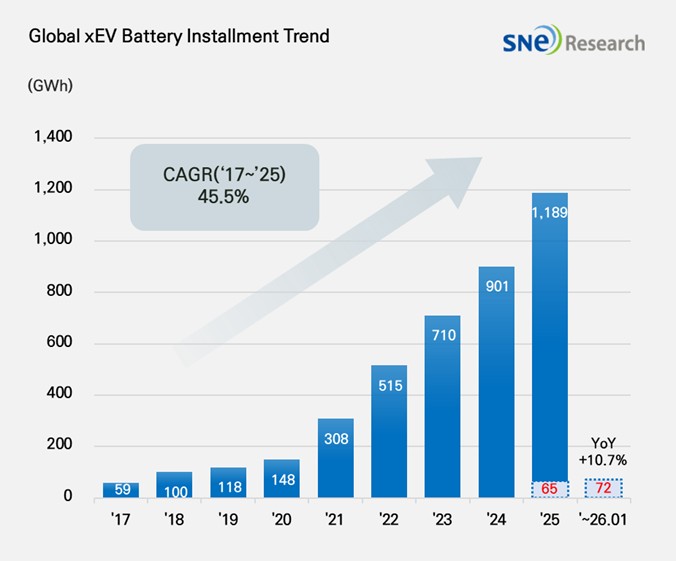
In Jan 2026, the amount of energy held by batteries for
electric vehicles (EV, PHEV, HEV) registered worldwide was approximately 71.9GWh,
a 10.7% YoY growth.
(Source: 2026 Feb Global Monthly EV and Battery Monthly Tracker, SNE Research)
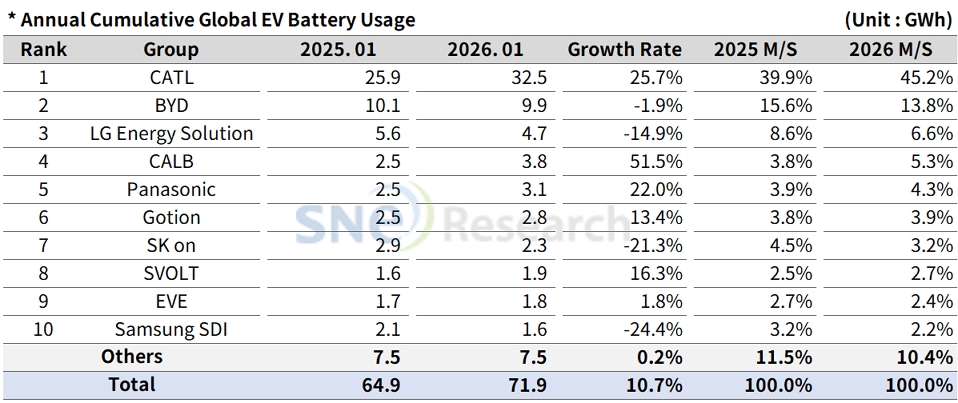
The combined market shares of LG Energy Solution, SK On, and Samsung SDI in global electric vehicle battery usage in Jan 2026 posted 12.0%, a 4.3%p decline from the same period last year. All three major companies experienced negative growth: LG Energy Solution decreased by 14.9% (4.7 GWh), SK on by 21.3% (2.3 GWh), and Samsung SDI by 24.4% (1.6 GWh) year-on-year. This is analyzed to be primarily driven by a 30.2% plunge in EV sales in the U.S. market.
(Source: 2026 Feb Global Monthly EV and Battery Monthly Tracker, SNE Research)
Analyzing the battery usage of the three major Korean cell makers alongside vehicle sales trends, Samsung SDI’s supply was highly concentrated in BMW, Audi, Rivian, and Land Rover, in that order. Although BMW utilizes Samsung SDI batteries for its key electrified models such as the i4, i5, i7, and iX, the installation volume declined due to slowing sales in the U.S. market. For Audi, while the PPE platform-based Q6 e-Tron equipped with Samsung SDI batteries received a relatively positive response in Europe, the overall installation volume decreased due to the ongoing sluggish sales of the existing Q8 e-Tron. Rivian continues to use Samsung SDI batteries for the R1S and R1T; however, growth was limited by an increasing proportion of 'Standard' trims and the general downturn in the U.S. market.
SK On’s battery installations were primarily driven by key OEMs, including Hyundai Motor Group, Ford, Mercedes-Benz, and Volkswagen. Within the Hyundai Motor Group, IONIQ 5 and EV9 made significant contributions, while sales of Ford’s Puma and Explorer also supported SK On’s installation volume. However, several challenges loom: sales of the Ford F-150 Lightning—which is set to cease production by the end of 2025—have plummeted, and the dissolution of the BlueOval SK joint venture with Ford is expected to further weigh on SK On’s performance amid slowing U.S. demand. Furthermore, following the early termination of IRA tax credit benefits in September last year, sales of U.S. local OEMs slowed, and a sharp decline in sales from European and Korean OEMs made it difficult for SK on to avoid negative growth.
LG Energy Solution’s battery usage was primarily driven by major OEMs, including Tesla, Hyundai Motor Group, Renault, and Volkswagen. While global sales of Tesla models equipped with LGES batteries remained sluggish, key models such as Kia’s EV series and Hyundai’s Casper (Inster) EV showed resilient sales performance. However, due to the early termination of the U.S. IRA tax credits, sales of local OEMs—including Cadillac, Chevrolet, GM, and Ford—plummeted, leading to an overall downward trend in installation volume.
Panasonic ranked 5th with 3.1 GWh in battery usage for January 2026. Unlike the three Korean cell makers, Panasonic showed an upward trend, which is attributed to the relatively limited decline in Tesla's sales compared to other U.S.-based OEMs. To reduce its heavy reliance on Tesla, Panasonic is focusing on improving the efficiency of its North American production lines and developing 4680 and 2170 cells. As conversion work at the Kansas and Nevada plants accelerates, the cost structure is stabilizing, and the foundation for demand diversification is strengthening through increased cooperation talks with other North American OEMs. These strategies are expected to buffer risks from Tesla’s in-house battery production expansion and help defend Panasonic's mid-to-long-term market share in North America.
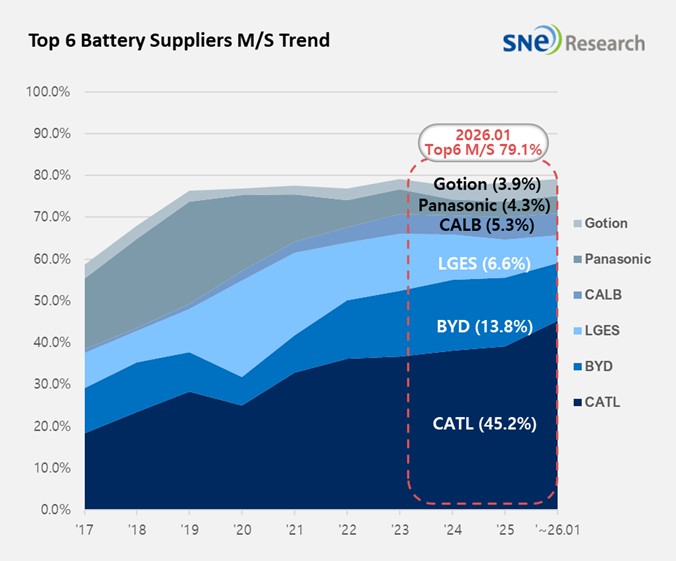
China’s CATL maintained its global No. 1 position, recording 32.5 GWh, a 25.7% increase year-on-year. The company expanded its installation base by supplying not only major Chinese OEMs such as SERES, Xiaomi, Li Auto, and Geely but also diverse global OEMs including Tesla, BMW, Mercedes-Benz, and Volkswagen. Significant growth in installation volume was observed across China, Europe, and other emerging markets (excluding the U.S.), while the trend of increasing average battery capacity among Chinese makers also contributed to its market share growth. While maintaining a lithium-ion-centered portfolio, CATL is strengthening its response to next-generation markets by pushing for the commercialization of sodium-ion batteries.
BYD recorded 9.9 GWh, a 1.9% decrease, yet maintained its position as the global No. 2. This result is interpreted as a shift in strategy, prioritizing overseas investment and sales expansion over domestic Chinese market growth. Regional trends diverged significantly: while installations in China fell by 23.4%, they surged by 69.4% in Europe and 97.6% in other regions. By internally producing both batteries and electric vehicles (BEV+PHEV), BYD is leveraging its cost competitiveness to increase sales across various vehicle segments, expanding its presence in international markets. Furthermore, to enhance cost efficiency, BYD is reportedly increasing investment in sodium-ion battery commercialization and working to establish a dedicated production capacity of 30 GWh per year.
(Source: 2026 Feb Global Monthly EV and Battery Monthly Tracker, SNE Research)
In 2025, the EV battery market was primarily driven by the massive influx of low-cost Chinese electric vehicles, which significantly disrupted global demand and competitive dynamics. While this price-centered expansion is expected to persist in 2026, the market is likely to enter a new phase. Tightening regional policies, regulations, and trade environments are shifting the focus from simple volume expansion toward a strategic balance between cost competitiveness, product value, and supply chain stability.
This transition is clearly reflected in recent data. As of January 2026, while global EV sales fell by 2.1% year-on-year, battery installation volume increased by 10.7%. This indicates that despite the slowdown in vehicle sales, battery demand remains relatively resilient, driven by expanding average battery capacity per vehicle and a shift in product mix toward higher vehicle segments and longer driving ranges.
By region, demand recovery in the U.S. has been hampered by heightened policy uncertainty following the inauguration of the Trump administration. In China, the world's largest market, growth momentum has also slowed as EV purchase tax benefits were slashed from 100% to 50% in 2026. Conversely, Europe continues to see resilient short-term demand, driven by stricter carbon regulations and the increasing influx of Chinese EVs. However, as supply chain and data requirements—such as regional industrial policies (Europe’s version of the IRA) and 'Battery Passports'—tighten, the growth trajectory centered on low-cost volume may face constraints, potentially leading to a moderated growth pace in the mid-to-long term.
Ultimately, future competition is likely to be realigned. It will shift from simple volume expansion led by low-cost products to a complex landscape where companies must simultaneously satisfy non-price requirements amid regional regulations, trade barriers, and localization demands. Both OEMs and battery makers must recalibrate their supply chain structures and product portfolios for each market. Success will depend on how quickly they can secure the optimal balance between cost, performance, and regulatory compliance.
[2] Based on battery installation for xEV registered during the relevant period.