

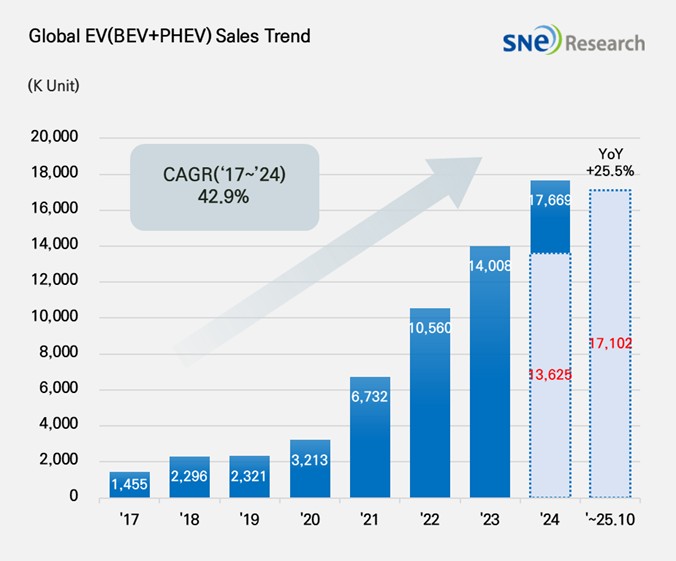
From Jan to Oct 2025, Global[1] Electric Vehicle Deliveries[2] Recorded Approximately 17.10 Mil Units, a 25.5% YoY Growth
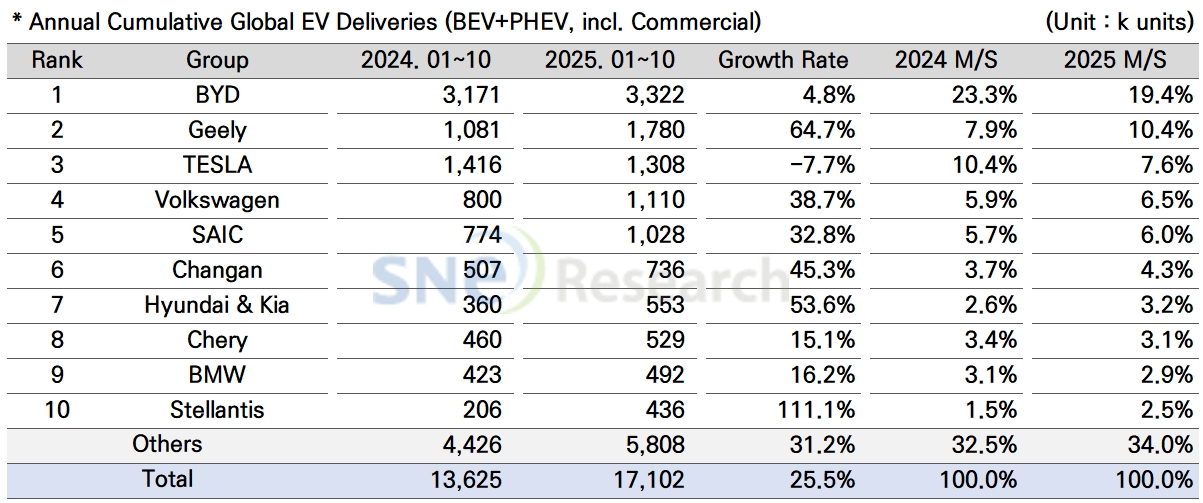
- BYD remained top by selling 3.32 mil units; Geely ranked 2nd with 64.7% growth
From Jan to
Oct 2025, the number of electric vehicles
registered in countries around the world was approximately
17.102 million units, a 25.5% increase from the same period last year (13.625
mil units).
(Source: Global EV and Battery Monthly Tracker – Nov 2025, SNE Research)
From Jan to Oct 2025, BYD remained top in the global ranking by selling 3.322 million units, recording a 4.8% YoY growth. BYD has been flexibly responding to recent changes in tariffs and subsidy policies by building production sites in the European region (Hungary and Turkey) the Southeastern Asian region (Thailand, Indonesia, and Cambodia). While steadily increasing its brand awareness based on price competitiveness and technology, BYD has been working to diversify its model line-ups from commercial vehicles to small vehicles to improve its competitiveness across the entire ecosystem for electric vehicles. BYD has lowered its annual sales goal from 5.50 million units to 4.60 million units, which is equivalent to around 7% YoY growth. The major background for this seems to be intensified competition among the Chinese OEMs in the electric vehicle market.
Geely Group, ranked 2nd on the list, continued to enjoy a double-digit growth by selling approx. 1.78 million units and posting a 64.7% YoY growth. Geely’s Star Wish(星愿) model is gaining popularity and contributing to expansion of line-ups. Its premium brand ZEEKR(极氪), hybrid-dedicated Galaxy(银河), and LYNK & CO(领克), aiming for the global market, are absorbing demands based on its multilayered brand portfolio. Geely Group has been very responsive in converting from internal combustion engine vehicles to electric vehicles. The group also accelerated the in-house development of technology for batteries, electrical equipment, and software as well as the increase of production capacities. These vertical integration and in-house technology development strategies have been evaluated as key drives behind the competitiveness of Geely. It seems that the Group is highly likely to expand its presence in the future global market.
Tesla ranked in terms of global EV sales by selling 1.308 million units and posting a 7.7% YoY decline. A slowdown in sales of Model 3 and Y (1.35 million units → 1.27 million units) has made the entire sales drop. By region, Tesla saw a 20.5% YoY decline in sales in the European market (210k units) and an 8.4% YoY decrease in the Chinese market (459k units). In addition, even in the North American market, Tesla posted an 8.4% YoY decline (516k units) in sales due to the termination of tax credit benefits offered to customers. Although Tesla continued to implement strategies to sophisticate FSD function and expand the monthly subscription-based software profit model, it seems Tesla would only see limited effects in noticeably improving sales in the short term.
(Source: Global EV and Battery Monthly Tracker – Nov 2025, SNE Research)
Hyundai Motor Group sold approx. 529k units of electric vehicles, recording a 15.1% YoY increase and showing a steady growth in the global EV market. In terms of BEV, IONIQ 5 and EV 3 were leading the growth of sales, while small-sized, strategic models such as Casper (Inster) EV, EV 5, and Creta Electric received well in the market. On the other hand, some of the existing models such as EV 6, EV 9, and Kona Electric showed a slowdown in sales, failing to maintain their growth momentum. In terms of plug-in hybrid vehicles (PHEV), Hyundai delivered a total of 90k units, with Sportage, Tucson, and Sorento maintaining a steady trend of sales, while Niro and Seed exhibited an obvious slowdown in sales.
In the North American market, Hyundai delivered 148k units, ranking 3rd in the market and following Tesla and GM. Despite posting 13.0% YoY decline, Hyundai still outperformed its major competitors such as Ford, Stellantis, Toyota, and Volkswagen. With the expanded sales of EV 3 in the global market, Hyundai has been diversifying its electrification portfolio by adding new line-ups such as EV 4 and IONIQ 9. By expanding the proportion of local production and infrastructure, Hyundai is expected to sustain a stable profit structure amidst market volatility caused by changing tariff and subsidy policies.
(Source: Global EV and Battery Monthly Tracker – Nov 2025, SNE Research)
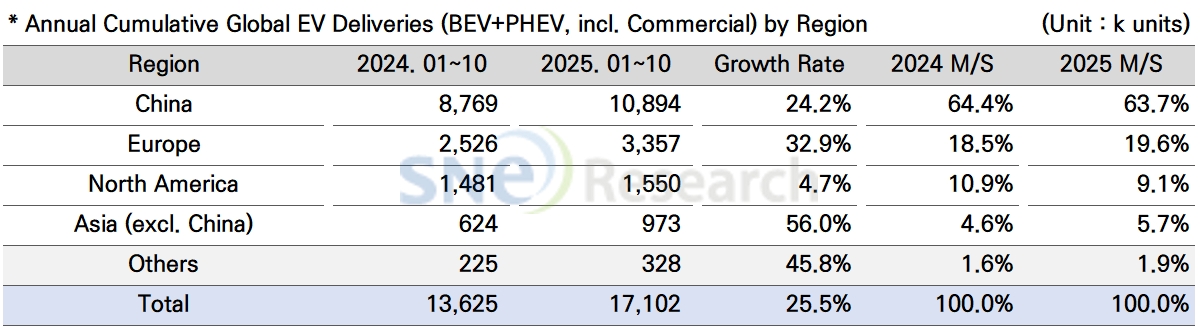
From Jan to Oct 2025, the global electric vehicle (EV) market has shown divergent trends across regions, with growth patterns varying significantly depending on each country’s policy environment and demand structure.
In China, accounting for the biggest market share of 63.7% in the global market, a total of 10.894 million units of electric vehicles were sold, recording a 24.2% YoY increase. Although the growth of Chinese domestic market has slowed down, demand for mid-to-low price, entry-level electric vehicles has continued, and the electrification of commercial vehicles maintained. In particular, major OEMs such as BYD, Geely, and SAIC have been increasingly exporting to overseas markets including Europe and Central and South America, while accelerating their effort to vertically integrate their local supply chains. This diversification of technology and export strategies indicates that the growth axis of China’s EV industry is shifting from domestic demand to a globally oriented supply-driven model.
In Europe, a total of 3.357 million units of electric vehicles were sold, posting a 32.9% YoY growth and taking up 19.6% of global market share. Recently, the growth of European EV market was led by mid-size SUVs and crossover vehicles such as ID.4, Q4 e-Tron, EV3, Elroq, and iX1. These models, designed for practical family-oriented demand, combine high efficiency and affordable pricing while leveraging universal electrification platforms such as MEB and PPE, driving rapid market expansion. Moreover, major OEMs including Volkswagen, Volvo, BMW, and Mercedes-Benz are strengthening platform integration strategies to improve production efficiency and simplify their model lineups. This trend is emerging as a key factor reshaping the European EV market structure, shifting its focus toward mid-sized vehicles.
In the North American market, a total of 1.550 million units of electric vehicles were sold, recording a 4.7% YoY growth. The market share of North American market has slightly dropped to 9.1%. At the end of September, the expiration of consumer tax credits under the Inflation Reduction Act (IRA) led major OEMs to launch aggressive promotions aimed at clearing inventory and boosting sales, resulting in a short-term surge in EV deliveries. However, after that, the EV sales in October showed a 50% decrease from the previous month and 30% drop from the same month last year. On the other hand, GM, Ford, and Hyundai Motor Group are adjusting their strategies by reshaping their lineups around mid- to low-priced segments and expanding hybrid models. In the North American market, temporary volatility is increasing due to changes in tax policy, while local production share and price competitiveness are emerging as the key factors determining future market share.
The Asia market (excluding China) exhibited a 56.0% YoY growth with 973k units of electric vehicles sold, accounting for 5.7% of the global market share. In India, the adoption of small electric vehicles priced between USD 10,000 and 20,000 is expanding rapidly, with Tata Motors and Mahindra leading market growth. In Thailand and Indonesia, Chinese OEMs such as BYD, SAIC, and Chery have begun full-scale operation of local plants, strengthening these countries’ positions as regional production hubs. In contrast, global OEMs are responding by focusing on localized pricing strategies and model customization tailored to local demand structures, prioritizing market adaptability over the speed of electrification. In Japan, Toyota and Honda continue to pursue hybrid-centered strategies while gradually expanding their BEV lineups.
In 2025, the global electric vehicle (EV) market continues to grow, but regional differences in demand structure and policy environments are becoming even more pronounced. In November, the European Union and China reached an agreement to replace the previously discussed high additional tariffs on Chinese EVs with transitional tariffs and an adjustment period extending to 2029. For China, this arrangement represents a compromise—accepting a certain level of regulatory burden while still maintaining access to the European market. On the domestic front, China saw a significant milestone: in October, new energy vehicles (NEVs) accounted for 51.6% of wholesale sales, surpassing internal combustion engine (ICE) vehicles for the first time. In response, the Chinese government is pursuing consumer stimulus measures and subsidy adjustments aimed at both supporting economic recovery and phasing out older ICE vehicles, while ensuring the continued growth of NEVs. China’s policy direction—balancing profitability protection, domestic demand stabilization, and external market access—is expected to have a meaningful impact on global EV pricing structures, supply chain realignment, and the shaping of future trade rules.
[2] Based on electric vehicles (BEV+PHEV) delivered to customers or registered during the relevant period